

Brig. Gen. William "Billy" Mitchell standing by a V.E. 7 at Bolling Field, D.C. Air Tournament, May 14 -16, 1920. The Vought VE-7 Bluebird was an advanced military trainer, observer and fighter of World War I. U.S. Air Force photo
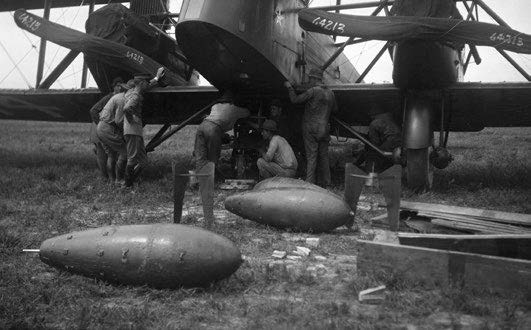
Ground crew loading ordnance on a Martin MB-2 Bomber, circa 1921, likely in support of aerial bombing exercises in conjunction with the navy. A.W. Smith Collection Naval History and Heritage Command photo.
Over one hundred years ago powered flight turned eighteen years old. In 1921 the U.S. Air Force did not exist, rather it was a part of the U.S. Army as the U.S. Army Air Service. The Royal Air Force was three years old. Aircraft carriers were few in number and experimental, while planes had ranges of only a few hundred miles. As it had for centuries, naval strategy centered around the battleship as the core of a fleet. A century later airpower is an important part of the U.S. Armed Forces, and aircraft carriers have replaced battleships as rulers of the waves. This transformation began in significant measure because of the actions of aviators, led by Wisconsin’s General William L. “Billy” Mitchell, over a few weeks in the summer of 1921.
A New Dimension of Warfare
As the United States demobilized after World War I, it was clear that the airplane had introduced a new dimension of warfare. Some air power advocates, of which Mitchell became a leading light, argued for an independent U.S. Air Force which would render surface ships and land forces obsolete or irrelevant. At the same time, the U.S. Navy was undergoing a fleet modernization program with many battleships on the drawing boards. These plans and debates progressed against a backdrop of defense budget cuts and retrenchment, which meant air forces had to compete with ground and sea forces for shrinking resources. The outcome of these debates would have real-world consequences for the American military for years, if not decades, to come.
In the fall of 1920, the navy quietly tested aerial bombing on the obsolete battleship USS Indiana, anchored in Chesapeake Bay. The navy and marine aviators failed to sink her. “The entire experiment,” Wisconsin-raised Captain William D. Leahy reported, “pointed to the improbability of a modern battleship being either destroyed or completely put out of action by aerial bombs.” A furor arose when word leaked that the fliers were not using real bombs, rather sand and rock packages dropped on targets painted on deck. Congress got involved, and ordered the navy to prepare more realistic bombing tests in the Atlantic. These would use live ordnance and involve fliers from the navy, marine corps, and the army – a true exploration of air power’s potential effects on surface ships.
Planning the Tests
To take part in the tests, Mitchell assembled 1,000 men and 125 planes of the Army Air Service into the 1st Provisional Air Brigade at Langley Field (today Langley Air Force Base) near Hampton, Virginia. A period of intense training perfected his men in both level and dive-bombing techniques. Mitchell and his fliers also learned that near-misses could be as effective as direct hits, because of the resulting water pressure wave, which the fliers called a “water hammer.” Mitchell led from the front, and announced he would accompany all missions to the targets. He emphasized to his pilots that the test results would determine “the whole future of our force [the Air Service].”
For targets, the navy provided German ships surrendered after World War I: submarine U-117, destroyer G 102, cruiser Frankfurt, and battleship Ostfriesland. They would be anchored fifty miles off the Virginia coast, a two-hour flight time from Langley. All were modern ships and combat veterans. Ostfriesland in particular was ten years old and exceptionally well-designed to take damage and stay afloat. The army and navy senior leaders negotiated rules for the tests, limiting the size of bombs and tactics that could be used. A control party aboard USS Shawmut would direct the tests, while VIPs aboard transport Henderson and the rest of the Atlantic Fleet looked on. Naval parties would board the ships after a certain number of hits to assess damage, and if needed, the Atlantic Fleet would finish off any target ships that failed to sink.
The first test was U-117 on June 2. Two passes by three navy seaplanes sent her to the bottom in minutes, the speed of destruction surprising all observers. A few days later Mitchell’s flyers went after G 102, which they had been allowed to attack with a fairly free hand.
After strafing and topside damage by pursuit planes, Mitchell’s bombers dropped accurate strikes on and around the ship, including a bomb down the stack. G 102 broke in half and sank quickly. On July 18, Frankfurt succumbed to similar tactics, with the initial waves provided by navy and marine corps flyers. The first two targets were lightly-armored, whereas Frankfurt was much better protected. Nonetheless, the fact remained that planes alone had sunk three modern ships.
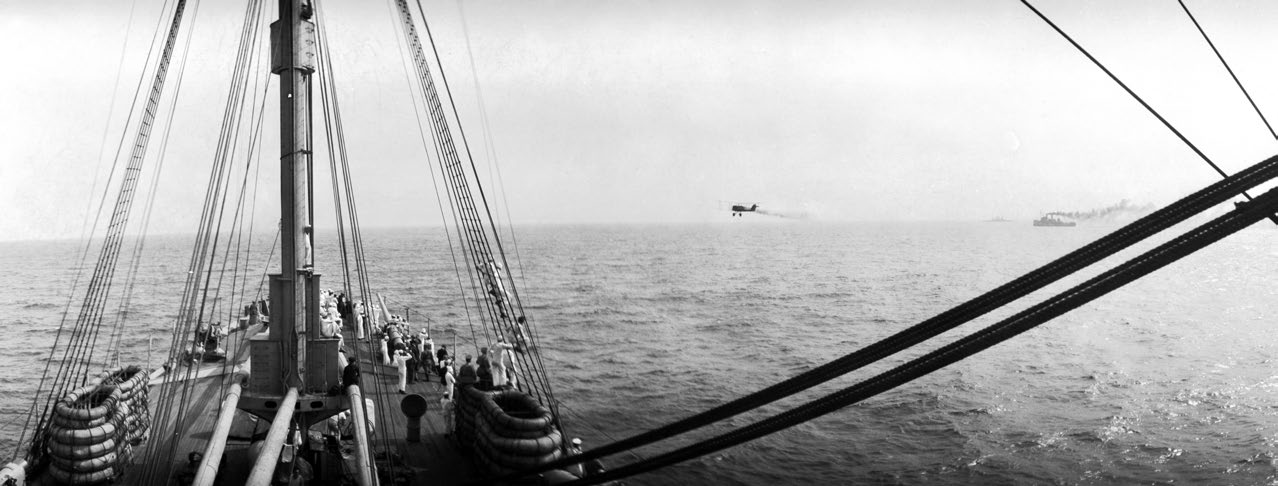
A DH-4 bomber flies low, past the starboard side of USS Henderson (AP-1). Henderson hosted press reporters, military officers, and foreign observers as they observed the 1921 Army-Navy bombing experiments off the Virginia capes. A.W. Smith Collection Naval History and Heritage Command photo.

Shawmut (CM-4) 1907 at left, photographed off the Virginia capes during aerial bombing experiments in which the Ostfriesland was sunk as a target. Shawmut, renamed Oglala in 1928, served as a control ship in the tests. This photo was taken on 21 July 1921. Naval History and Heritage Command photo.

Former German battleship (1911-1920), photographed after it was taken over by the U.S. Navy. The USS Ostfriesland was commissioned 7 April 1920 and decommissioned 20 September 1920. Photo credit: Naval History and Heritage Command.
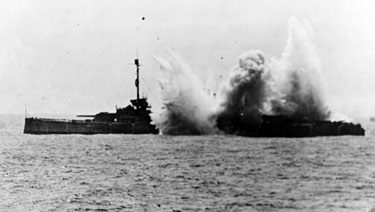

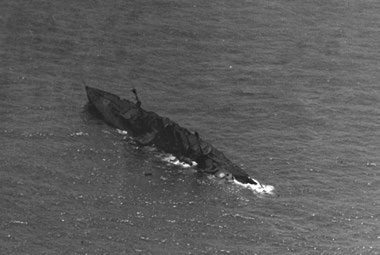
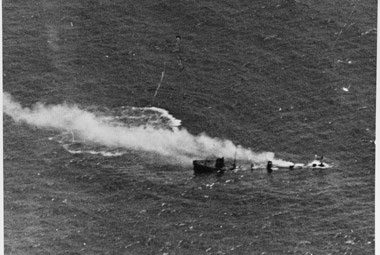
Images of the USS Ostfriesland sinking off Hampton Roads, Virginia after being used as a bombing target. Photo credit: Naval History and Heritage Command.
Sinking the Ostfriesland
Despite these successes, the biggest prize still needed bagging. “This was our real test,” recalled Mitchell in 1925. “If we could not sink this great ship the efforts against the other smaller vessels would be minimized and the development of air power against shipping might be arrested, at least for the time being.” On July 20 the strikes against Ostfriesland commenced. navy and marine planes raked Ostfriesland’s decks with smaller bombs and were just flying away when Mitchell and his planes arrived in the afternoon. After circling for almost an hour while damage was assessed, the Army fliers were allowed to attack. Thousand-pound bombs struck on and around the ship, leaving her wounded but afloat. Damage parties went aboard and found her listing and down by the stern, with flooding.
Mitchell’s planes returned the next morning, July 21. At 8:32 Lieutenant Clayton Bissell led a string of six planes into an attack, scoring several hits with thousand-pound bombs and leaving Ostfriesland a wreck. Damage parties went aboard again and confirmed that in wartime, the battleship may have been able to make it home, but was almost certainly combat ineffective. Three hours later Mitchell returned with ten planes each carrying two-thousand-pound bombs. They dove in succession and struck accurate hits around the ship, which created the “water hammer” effect and broke open Ostfriesland’s hull. After six bombs it was clear no more were needed. “When a death blow has been dealt by a bomb to a vessel,” recalled Mitchell, “there is no mistaking it.” Captain St. Clair Streett, Mitchell’s rear-seat observer, stood up with waving arms and yelled, “She is gone!”
The wounded battleship listed further to port. Her stern dipped lower, and sluggishly she rolled onto her port side. Within a few minutes she was upside down. Her stern sank and the bow clawed at the sky before descending. A minute later Ostfriesland was gone, leaving a bubbling spot of water on the surface. A plane dropped a bomb into the bubbles to punctuate the victory. Several admirals wept as Ostfriesland slid beneath the waves. The news of the sinking shocked military circles. For airpower advocates, it was a huge boost. Mitchell repeated his performance in nearby waters against USS Alabama in September 1921, and two years later against USS Virginia and USS New Jersey. Soon aircraft and air power assumed larger roles in U.S. strategy. Mitchell regarded these tests as definitive and said that “aircraft constitute a positive defense of our country against invasion.”
“We wanted to destroy her from the air, but when it was actually accomplished, it was a very serious and awesome sight.”
— General Billy Mitchell
Beginning of U.S. Air Supremacy
Many of the participants in the tests went on to have prominent careers. Streett later commanded bomber operations in World War II and was instrumental in forming Strategic Air Command. Henry H. “Hap” Arnold flew a plane in the tests and later was commander of the U.S. Army Air Forces in World War II. Clayton Bissell helped develop air doctrine and commanded Tenth Air Force in World War II. Among the navy and marine corps participants, Roy Geiger and Francis Mulcahy pioneered Marine Corps aviation, holding prominent commands in the Pacific, while Felix Stump did the same for the Navy. For all of these men, participation in the bombing tests of 1921 was a major professional milestone.
For Billy Mitchell, the sinkings off Virginia in 1921 proved a zenith of his career. His achievement reinforced the case for aviation’s future promise. Naval aviators successfully pressed for development of aircraft carriers and air units for the fleet, while army pilots used Mitchell as a guide and inspiration for their doctrine and organization through the World War II years and beyond. The effects of both of these efforts are still apparent in the navy and air force today.
The lessons of the bombing tests remained open for some debate in naval circles, chiefly because the ships were stationary and not defending themselves. Mitchell’s feat was partly replicated in 1940 by the British raid on Taranto and in December 1941 by the Japanese raid at Pearl Harbor, but in both cases the target ships were stationary in harbor. The sinkings of HMS Prince of Wales and Repulse by Japanese aircraft off Malaya on December 10, 1941, made it clear the age of the battleship as dominant naval vessel was closing. The destruction by American planes of Musashi in October 1944 and Yamato in April 1945, the most powerful battleships afloat, removed any final doubt on that score. What Mitchell’s successes in 1921 foreshadowed had come to pass.

An American plane drops a phosphorus bomb on USS Alabama, September1921. Photo credit: Naval History and Heritage Command
Admirals Wept: Billy Mitchell was written by Chris Kolakowski, Museum Director at the Wisconsin Veterans Museum.
The article was first published in the Spring 2021 issue of The Bugle.