
Meeting James “Maggie” Megellas will always be a highlight of my career with the Wisconsin Veterans Museum. Growing up, the World War II generation was almost larger-than-life in my perception. I was fortunate to grow up on stories from my grandparents and their generation at the peak of public memory that began celebrating them in earnest with the 50th anniversary of the war. Public attention and entertainment media continued to increase that trajectory, building on the foundation established with the classics such as The Longest Day and A Bridge Too Far with the release of movies such as Saving Private Ryan and video games like Medal of Honor and Call of Duty. The influx of popular culture related to that conflict only further solidified and secured the cultural image of that ‘Greatest Generation.’ I would be kidding myself if I didn’t recognize the part all of that played in influencing my life choices that led me to the Wisconsin Veterans Museum.
For me, getting to meet veterans is like meeting a celebrity I have idolized since I was young. In 2011, I had the distinct pleasure to meet a true ‘hometown hero’, James “Maggie” Megellas. What I knew of him at the time was minimal but still mighty—he was a highly decorated WWII paratrooper that had seen a lot in his time with the 82nd Airborne from Italy to Holland and Germany. I knew he had written a book about his experience, and that he was the basis for John “Cliff” Ratzenberger’s character in the movie A Bridge Too Far (although his character was officially only credited as “U.S. Lieutenant”). Only knowing about his battlefield exploits—from being wounded twice in Italy, to the heroic crossing of the Waal River during Market Garden, to fighting off the SS in the Battle of the Bulge and single-handedly taking out a tank to save his platoon—I had created a picture of Megellas as a tough-as-nails, stern soldier with a firm handshake, intimidating demeaner, and definitely aware of his own deeds and actions. I truly don’t think I could have been more off base.
As one of the guest speakers at our Operation Greatest Generation event in Green Bay, his remarks hardly referred to himself at all or even what he experienced. His entire speech focused on his ‘buddies’, his ‘friends’, his ‘comrades in arms’ that were gathered in the audience—around 350 WWII veterans from across the state. Even when I asked him to sign my copy of his book, he asked about WWII veterans in my family and inscribed a note on the title page in honor of my grandfather who had recently passed. It was evident to me from that day onward, that Jim “Maggie” Megellas would be the first to tell anyone that he didn’t do it alone.
He would always emphasize the contributions of his “battle buddies” and “comrades in arms.” His insistence on that made sure the recognition was not—and should not be—on him alone, but rather to everyone who actually or symbolically served with him. Over the course of the next eight years, I learned a lot from him and Carole, his wife, every time they returned to Wisconsin or when we’d chat on the phone.
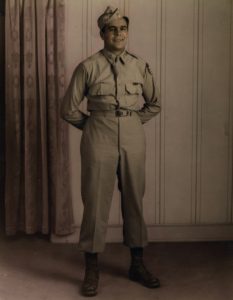
James Megellas in uniform during WWII, James P. Megellas Collection.

John Ratzenberger and James Megellas in Dallas at a fundraiser; Actor John Ratzenberger portrayed War Hero Megellas in the 1977 film A Bridge Too Far. Author K. Novak, via Wikimedia Commons.
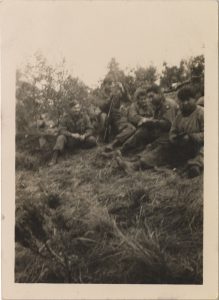
Battle Buddies - pictures of a platoon in Holland Sept 1944 from the James P. Megellas Collection.
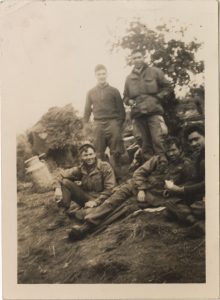
Battle Buddies - pictures of a platoon in Holland Sept 1944 from the James P. Megellas Collection.
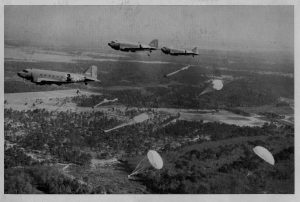
Paratrooper drop from WWII, James P. Megellas Collection.
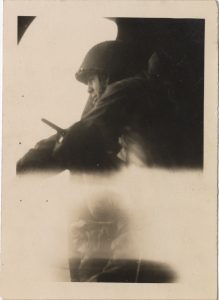
Paratrooper Megellas "a couple of minutes before the Holland invasion" according to the caption in his scrapbook, James P. Megellas Collection.
Wisconsin Beginnings
Born in Fond du Lac, Wisconsin in 1917, James “Maggie” Megellas was a first generation Greek-American. He was in the Reserve Officer’s Training Corps (ROTC) program at Ripon College after previously working with the Civilian Conservation Corps after high school. Humbly, he’d say that he didn’t consider himself a born leader; that he was just trying to get by like everyone else. Looking at his choices from early in life and before the war though it’s clear that he was always driven to take the initiative to do something, to be part of something bigger than himself. It was in his senior year at Ripon that the United States entered World War II.
World War II Service
Originally assigned to the Signal Corps upon graduation in May 1942, Megellas was eager to find the quickest route that would get him overseas and into the thick of the war, first volunteering to be a glider pilot and then the fledgling airborne paratroopers of the U.S. Army. After initial training at Fort Benning and more in North Africa, Maggie joined the 82nd Airborne as a replacement in Company H, 504th Parachute Infantry Regiment just after Thanksgiving Day 1943. He endured the harsh winters in the mountains of Italy before partaking in the assault landings at Anzio in January 1944. It was during the fighting around Anzio that Maggie was wounded twice and received his first two awards, a Purple Heart for the first and an Oak Leaf Cluster for the second.
Maggie’s first combat jump was Operation Market Garden in September 1944. In the fighting around Nijmegen, Holland, he crossed the Waal River in the daring daylight assault in canvas boats and conducted a bold night raid on enemy positions which ended with him carrying a wounded man with his left arm and aiming his tommy gun with his right. His heroics were rewarded with the Distinguished Service Cross, the nation’s second highest award, next to the Congressional Medal of Honor. His further exploits during the Battle of the Bulge earned him his first Silver Star medal. His second Silver Star cane only a month later where he single-handedly knocked out a German Panther tank that threatened to annihilate his entire platoon during an offensive in the heavy snow outside Herresbach, Belgium.
On May 2, 1945, at the close of the war in Europe, Maggie and his platoon were the first to liberate Wobbelin Concentration Camp.
Later in life, Maggie reflected, “I was not prepared mentally to deal with the horror of the camp… it was not until our men witnessed this that we fully realized what we had been fighting for. The destruction of the monstrosity the Nazis had created was the cause greater than ourselves that we had often alluded to but never fully understood. It was a defining moment in our lives: who we were, what we believed in, and what we stood for.”
Megellas Serves at Home
Maggie’s desire to serve others and his country didn’t end with the war. After he returned home to Fond du Lac, he served as the president of the city council before running for Wisconsin State Assembly in 1956 and then for Congress in 1958 and 1960. It was during this time that he met two very important people: his future wife Carole when she took a job working as part of his campaign team and John F. Kennedy when he was campaigning for president. Kennedy and Maggie became close friends, and President Kennedy appointed him to a mission director position for the United States Agency for International Development (USAID) first to Yemen and then to Panama. During the Vietnam War, Maggie served as Deputy for Civilian Operations and Revolutionary Development Support (DEPCORDS) with the U.S. Military Assistance Command, Vietnam (COMUSMACV) for diplomatic endeavors. By 1975, he again served with USAID as mission director in Colombia. When he retired from the State Department in 1979, he returned to the U.S. to serve in another capacity: as an economics and international affairs teacher with the Florida Institute of Technology for nine years.

Megellas revisiting the old battlefield at Herresbach. Belgium., James P. Megellas Collection.
“The greatest generation has not yet been born. They will be the generation that does not send its young people off to die in wars but rather learns to live in peace.”
-- James Megellas
The Most Decorated Officer in the 82nd Airborne
To this day, Maggie is widely considered the most decorated officer in the 82nd Airborne having earned the Distinguished Service Cross, two Silver Stars, two Bronze Stars, two Purple Heart Medals, and countless other national and international recognitions in his veteran lifetime. He was already highly decorated at the end of World War II when General James Gavin, the commander of the 82nd Airborne Division, selected him to be the representative when the Netherlands wished to bestow their nation’s highest honor, the Orange Lanyard of the Military Order of William, as a unit award for the valiant efforts of the entire division in their liberation during Operation Market Garden.
Lessons from Megellas
Even with such recognitions, his thoughts and advocacy were always directed toward others. He was very blunt and honest about his wartime experiences – about the brutality of it all, and the mindset they needed then to carry out the missions that today earn our praise. His honesty and frankness instilled a sense of trust and authority on morals and values that I didn’t fully understand or appreciate in the time that I knew him. He didn’t sanitize the stories in any way in order influence your perception of him which took a courage we don’t often talk about or recognize in the moment. He was unapologetically honest about the brutality of war and what the world needed those young soldiers to be. He always shared that he subscribed to the philosophy that “the greatest generation has not yet been born. They will be the generation that does not send its young people off to die in wars but rather learns to live in peace. The Lord did not put us on this earth to kill each other.”
During his final visit to Wisconsin, he shared with me what he wanted to ‘tell his friends’ (as he always referred to everyone he met as a ‘friend’):
“The cause we fought for [was] greater than ourselves…. [we believe in] respect for others, respect for other’s rights, equal opportunities, respect for authorities, respect for our parents, respect for teachers, respect for everybody else. That’s what we fought for. And we fight to preserve those… If you want to honor me and you want to honor veterans, and those we didn’t bring back, then you abide your lives by those principles by which we fought… Be proud to be an American. We are a unique, distinct people. We stand for something. We believe in something. And we always will.”
Meeting James “Maggie” Megellas always will be one of the highlights of my life, but getting to know him was truly an honor.
Megellas passed away on April 2, 2020 at the age of 103. He is buried at Arlington National Cemetery in Arlington, Virginia.
You can view more about James Megellas here.

James Megellas: Meeting a Hero – Knowing the Person was written by Kevin Hampton, Curator of History at the Wisconsin Veterans Museum. The article first appeared in the Fall 2024 issue of The Bugle.