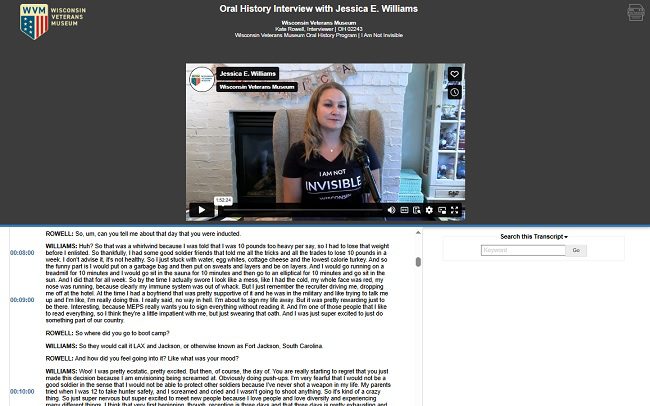
With a college degree, Jessica E. Williams could have entered the United States Army Reserve as an officer. Instead, she chose to enlist and take a different leadership path.
Williams, who grew up on a five-acre farmette in Oshkosh, Wisconsin, had not originally intended to join the military. But after graduating from Alverno College, an all-female college in Milwaukee, she felt she still had additional exploring to do.
Williams took the Armed Services Vocational Aptitude Battery (ASVAB) and passed, but she was one point shy of having the military pay her student loans. Instead, she took a job at the Wisconsin Challenge Academy, an alternative education program for at-risk youth at Fort McCoy.
After talking with soldiers who served in Iraq and Afghanistan, Williams again began to consider a military career. She took the ASVAB once more, got the score she needed, and talked to recruiters from several military branches, looking for the best offer. She negotiated a human resources position with the Army Reserve that would pay her student loans and included an enlistment bonus.
“I was 24. I’m a little blunt as it is, and I know my worth,” Williams says.
Rather than enter as an officer, Williams enlisted to experience leadership from the ground up. “I strategically decided to go in enlisted because I talked to many soldiers, and I wanted to earn that respect. I wanted to be boots, ground and really experience it before I started telling people what to do,” she says.
Williams entered basic training in 2011 at Fort Jackson in South Carolina. She found that being older than the other recruits created some friction.
Williams on being labeled by other recruits during basic training:
WILLIAMS: I was the mother hen. I'm 24. The rest of the females especially my bay 18, 19 years old. So, maturity was definitely a problem and that's something I didn't even think of. I was all concerned about the drill sergeants yelling at me and if I'm going to do something correctly. And what actually I struggled with is, I'm doing the right thing by basically following the rules. I'm a rule follower, always been and so on. Some of the girls would not like to follow the rules or weren't comprehending it was a struggle for me to like how do I support and not tell them what to do because I was the mother hen according to them. So, I realized that, you know, I have the personality and the organization. But I think the result, the realization was ideally when you're going into the military with a college degree, you should be an officer. I chose not to go in as officer. I went in as an enlisted soldier, so a specialist. So, with that being said, I'm a leader of the soldiers, but I'm not the planner. And that's what the officers are. And I have a strategic planner in my brain. So, I think that made it even more difficult because I acted as if I was an officer, now not disrespectfully, not like rank-wise, but just the outward thinking, the planning, like, why are you guys doing that? Like this is how it should be done. Think smarter, not harder.
At advanced individual training (AIT) and also at Fort Jackson, Williams trained as a human resources specialist. After AIT, she served with the 646th Regional Support Group, 377th Theater Sustainment Command in Madison, Wisconsin. In 2015, her sergeant major nominated her to compete in the Best Warrior Competition, an annual contest overseen by the Department of the Army in which soldiers compete in aptitude, physical fitness, soldier tasks and drills, and military bearing.
She was runner-up at the battalion level and competed a second time at the brigade level when the battalion winner could not compete.
Williams views the Best Warrior Competition as a highlight of her military career. “It almost felt like a form of deploying. I’ve never deployed, unfortunately, but it allowed me to feel like I was doing something to represent my command,” she says.
Williams on training for the Best Warrior Competition:
WILLIAMS: So, I had a couple of leaders. Yeah, this one right here, Sergeant Harding. So, he really was the sergeant that made me a true NCO, truly. So, he got some Army Guard Reserve AGR [Active Guard Reserve] soldiers on board and interviewed me four times to give me practice for the board, because a board is the military equivalency of like a job interview. That's a lot, because you have to think on your feet. You have to be game ready for any question that they throw at you. And of course, they all had to be goofy and try to make fun of me, try to make sure I wouldn't laugh that way. I could keep my composure because again, this is a military. I can't use my hands, I can't smile, have to be a little bit more strict. So, he was huge. I also had a Marine, Garbo. He was fantastic. He showed me the proper way of packing my rucksack. Apparently, the Army doesn't teach you that, but the Marines know. So, he actually took me on a couple ruck marches with the pack and gave us some great pointers, and I did really well on the ten-mile ruck march. And then my other good friend Bob. Bob Niles was focusing on weapons in the Navy for seventeen years, and I was really scared of the nine mil. I don't know what it was, but the M-16, the M-4, that's big weapons. I'm totally fine with it. But the nine mil, woo! Small guns I don't like. So, he took me to the range, and he helped me figure out my breathing and to get over the anxiety. And the coolest, bestest part was at the actual competition. I got thirty-seven out of forty with the nine mil and that put me at number one against all competitors.
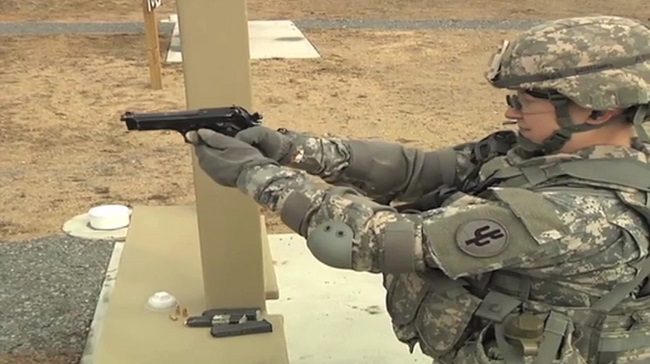
Jessica Williams during Best Warrior 2015 M9 Qualification. Williams hit 37 out of 40, highest score among the competitors. The appearance of U.S. Department of Defense (DoD) visual information does not imply or constitute DoD endorsement. DOD #102409371 screenshot. Public domain.
While serving in the Army Reserve, Williams worked in a civilian job as a National Guard contractor with the Armed Forces Reserve Center in Madison, where she assisted veterans with the transition to civilian life. This position provided helpful experience in her Army Reserve role, she says. Her sergeant had her work with soldiers who struggled in their civilian lives. One soldier, for example, lacked family support, didn’t have a driver’s license, and didn’t have a job outside the Army Reserve. She helped him with his resume and interviewing skills. She also brought him to and from drills until he got his license. “At the end of the day, if your soldiers fail or anything happens, it's not their fault, it's your fault,” Williams says. “And that's something that civilians don't do. But the military is very much no, it's the leader's problem.”
Williams on her civilian job as a job connection program manager with the National Guard:
WILLIAMS: I got the job right after I enlisted in the military. It wasn't a qualifier to have this position, but it really did help. And the best thing about this role is it was kind of dual. It was a completely civilian role, but it allowed me to be able to reach all the different branches. And by being a military member, I was able to better and deeply connect. That's why my career also took me to working for the Department of Veterans Affairs. Working with former Secretary Zimmerman under former Governor Scott Walker. And that was focusing on all Wisconsin veterans with higher education, entrepreneurship, and employment. So, within these two roles, it was always a focus on veterans. And I think a big part about like the VFW, the American Legions, all the various different veteran organizations out there, they're all very helpful, but they all are focusing on a certain branch or a certain person. And you have to look at the age gap too. Mine is more so the newest, I guess closest war that we've had, and I haven't deployed, but I've had I still have a story to tell. You have other soldiers that have been out for 20-plus years and their experience was very different, but at the same time still very much the same. And so, with that impact, it was really a hand, hand-in-hand, and I miss it.
Williams earned the rank of staff sergeant and trained as a career counselor at Fort Knox, Kentucky. As a career counselor, Williams’ main focus was on retaining soldiers. "I'm already in seven years, and I have been a pretty huge veteran advocate, and I want to make sure that when soldiers stay, they're staying for the right reasons and they get the benefits they deserve,” she says.
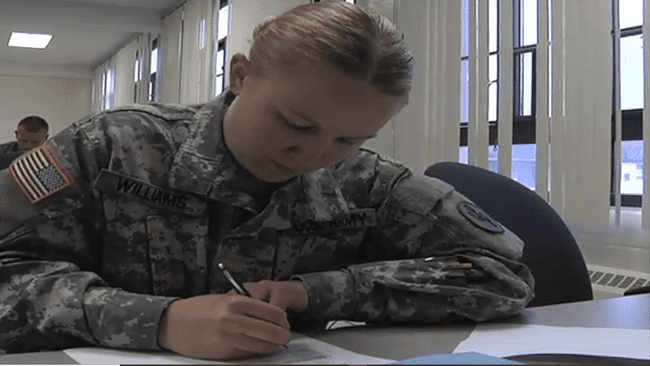
Jessica Williams during Best Warrior 2015 Written Exam. The appearance of U.S. Department of Defense (DoD) visual information does not imply or constitute DoD endorsement. DOD #102409371 screenshot. Public domain.
Williams also lent her talents to the Ask, Care, Escort (ACE) suicide prevention program and the Sexual Harassment/Assault Response and Prevention (SHARP) program. “I have a deep purpose of taking care of people and making sure they are feeling supported, desired, wanted, appreciated. And sometimes, I think we’re so busy focusing on the mission, focusing on making money or greed that people are lost,” she says.
In 2014, a fellow soldier sexually assaulted Williams. She had intended on becoming an officer but left the Army Reserve in 2020 because she says she did not get the support she needed to deal with the trauma of her sexual assault.
Although she had experience helping many others transition out of the military, Williams struggled with this transition.
Williams on transitioning out of the military:
WILLIAMS: I've been out since 2020, and it wasn't my goal. I wanted to go the officer route. I had the experience of that NCO. I was going to go that officer route, but as I mentioned, I didn't get that support from leadership. And I'm also going to admit that I was also a veteran that was suicidal, which is another reason why I feel so passionate about reaching out and helping because I've been there, and I think it's easier to help others when you've been there as well. You can have those feelings; you can ask the right questions. You can just tell them, I see you and I hear you, and we might not have the same story, might not have the same barriers, but we understand, and we have to find a way about how to care.
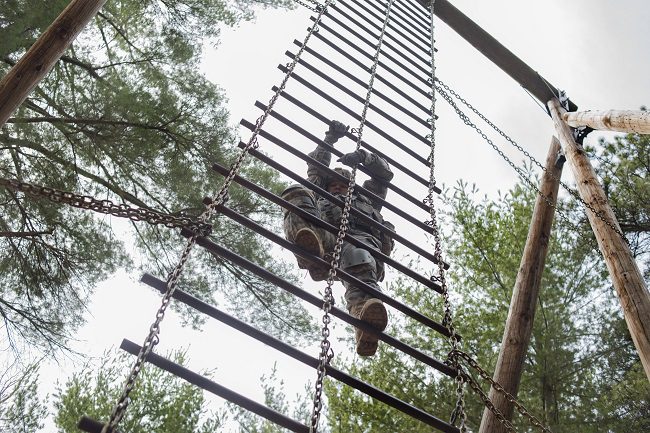
Army Sgt. Jessica Williams, a human resources specialist with the 646th Regional Support Group from Madison, Wis., elevates one step at a time on the Cargo Net Climb chain-linked ladder on the Confidence Course during the 377th Theater Sustainment Command Best Warrior Competition at Fort Devens, Mass." April 14, 2015. U.S. Army photo by Sgt. Ferdinand Thomas II. 377th Theater Sustainment Command. The appearance of U.S. Department of Defense (DoD) visual information does not imply or constitute DoD endorsement. 1875114. Public domain.
For the full interview, click on the image below: