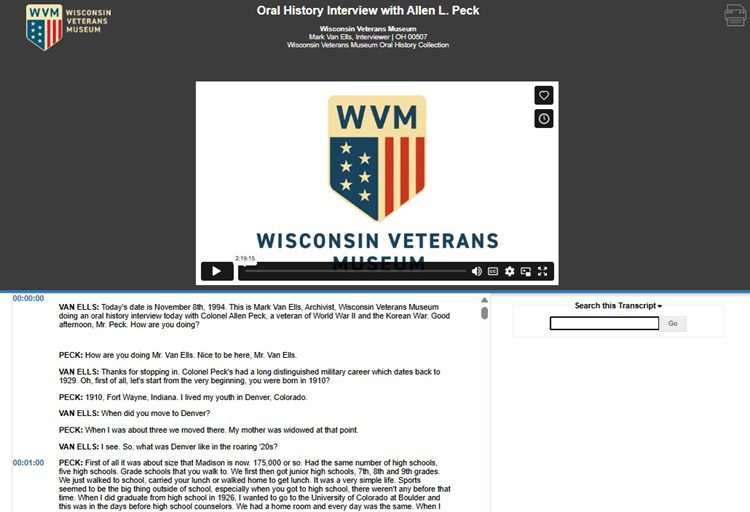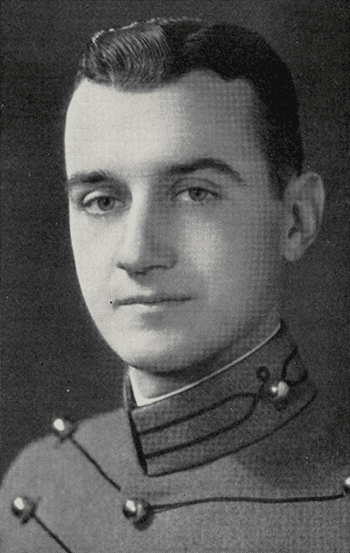
Cadet Allen L. Peck, pp. 184 extract. The Howitzer. 1936. United States Military Academy. West Point, NY: Published by the Corps of Cadets of the United States Military Academy. U410.N5.H84 1936.
The United States Military Academy Class of 1936 is noted for the number of graduates who went on to make significant contributions to the war effort in World War II, Korea, and Vietnam. Colonel Allen Leeds Peck (1910-1997) served in World War II and in the Korean War. He served as commander of the Provisional Battalion, 43d Infantry (Philippine Scouts) during World War II. The Japanese held Peck as a prisoner of war from May 1942 to August 1945. He survived two friendly-fire incidents during his ordeal.
Peck was born in Fort Wayne, Indiana, on January 11, 1910. At the age of 3, he and his mother moved to Denver, Colorado. He graduated from high school there in 1926 and attended the University of Colorado at Boulder for two and a half years. He wanted to attend the United States Military Academy at West Point, inspired by his mother and the memory of a father who had served in the Spanish-American War.
He was stationed in Mindanao, Philippines, in the isolated town of Zamboanga. He was tasked with training Philippine soldiers. In May 1941, and with tensions rising with Japan, families, including Peck’s wife, were ordered out of Zamboanga. When war broke out, Peck was a captain and was rapidly promoted to major.
At Zamboanga, Peck was second in command. On December 7, 1941, the Japanese attacked the naval base at Pearl Harbor, Honolulu, Hawaii, followed shortly by an air attack on Clark Field, on Luzon, the Philippines. Japanese landings started on December 22, 1941. Manila fell on January 2, 1942. The Japanese invaded Zamboanga on March 2, 1942. Zamboanga surrendered the same day.
On February 26, 1942, Peck’s battalion was ordered to move north to Bukidnon as instructors to the training school there. With MacArthur’s departure, Peck was isolated from other American commanders. In April 1942, Peck and his men were in the Cagayan/Del Monte sector. On May 9, 1942, Peck’s force was at Dalirig, covering the withdrawal of the Philippine Army's 62nd Infantry Regiment near the Del Monte airfield and plantation. Surrounded and cut off, Peck’s unit surrendered to the Japanese on May 10, 1942. Peck and his men were marched back to the Philippine Army training camp, now a prisoner of war camp. They were at that camp until November 1942, when they were trucked and shipped down to the former penal colony at Davao, southern Philippines.
Peck had an experience that was the exception rather than the rule to wartime experience for American soldiers, officer or not, in the Japanese-occupied Philippines. Peck, being an officer, was allowed a jeep to retrieve any wounded, disabled American or Filipino soldiers, or deserters, and to bury any dead. At a checkpoint on his return to Davao, the local Japanese commander invited him to dinner.
PECK: It wasn’t much of a dinner, they had rice and vegetables but turned out that he was the commander of the Japanese opposing me when I was in that area just before the surrender. So we compared notes, how much did I know about where he was. Which I knew a lot because I had to do a hand map. We had no maps - -oh yes, we did. We had a Mobile gas map and it showed main roads, one north and south, that was about it, and one around over by Zamboanga, other than that all the rest were blank [laughs]. But he knew much more than I had thought-- about us. It was interesting and the guy that was his interpreter was a graduate of some school in the U.S. and had taught school over there, in the U.S., before the war. Of course, he got back just in time to join their Army. But that was kind of interesting.
Unlike other Japanese Prisoner of War Camps, Davao was “fairly clean.” Prisoners could construct their own bunks. They were on a regimented, sunrise-to-sundown work schedule, with three scheduled meals.
The Americans were allowed some latitude in administering the work structure. The Japanese acceded to the American officers' argument that they could manage their men better than they could, but their captors could be mercurial.
PECK: And one time we were in a cornfield picking corn detail and some guys would find a baby ear and sort of gnaw on it. I guess the Japanese detectives, they weren’t in the field, they were around the field, lined us all up and made us open our mouths and stick our tongues out. If they saw any corn in anybody’s mouth, he was pulled out and just beaten down to the ground. Their punishment was rather merciless.
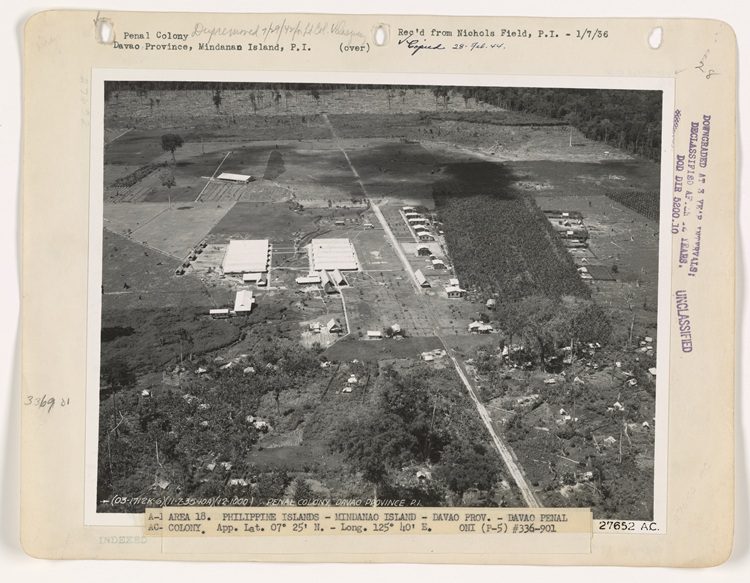
AREA 18. PHILIPPINE ISLANDS -- MINDANAO ISLAND -- DAVAO PROV. -- DAVAO PENAL COLONY. War Department. Army Air Forces. 6/20/1941-9/26/1947; National Archives and Records Administration. National Archives at College Park - Archives II (College Park, MD). RG-18-AA-182-28-ac.
Infractions, real or perceived, would land the offender in the brig, or worse:
PECK: So, they had these guys, now this is July or late June, and these guys tied to posts right out in the open where the barracks were. So they’re in the sun the entire time, no water, no nothing. And they were there a couple of days -- long enough so that each, all the prisoners, Filipinos and Americans, could troop on by and see them. This is what happens to guys who escape, they get caught. Later that day, they had us all out on a little hillside and across a little gully. Here are these two guys tied to posts. Two posts. Firing squad on this side, graves already dug right in front of them. They just fired, just killed ‘em. As we see firing squads do in movies and whatnot. But we were all there to watch. They cut them down and let their bodies tumble into this trench.
Punishments witnessed, and punishments threatened, and the location hindered reasonable assessments of effective escape:
PECK: We all kind of weighed the chances. We were 50 miles inland at the end of a road from Davao which was occupied by the Japanese of course. Nothing but forest around us, one volcano, Mt. Apo or whatever down there, and we’re white and everybody else in that area are colored. Brown skin for Filipinos, Hershey brown for Japanese. So you had to have a support group out there. You had to have something. You had to know the country. We all figured, so, better not.
Peck not only had to survive the rigors of forced labor and negotiate the whims of his captors, but he had to contend with the health risks to be found in a tropical zone:
PECK: Yes, there was a lot of malaria. I had malaria, oh, 20-25 times probably. It got so routine that the Japanese virtually paid no attention to it. If you’re--oh, hell, if it hits you maybe during the day, you’re out in the rice paddies, say, and they’d give you, let you rest the rest of the afternoon and maybe take tomorrow off and go back to work the next day.
Ulcers, malnutrition, dysentery, beriberi, and scurvy were very common among the Americans at Davao:
PECK: You all just lost weight gradually. We all got skinny, but you had a little strength left to keep doing things, but, see, the diets were primary rice, in Davao, they were augmented usually by a can of boiled vegetable soup. Leeks primarily. There was a plant we called kang kong, it was called kang kong. A long vine and tough-as-hell stems, but the fish would eat it or at least the leaves and so the Japanese gave us that to eat.
American prisoners wildly cheered the sight of American bombers on missions over Bataan. In early June 1944, Peck left Mindanao and began a journey north to various prison camps. They went to Cabanatuan and then to Bilibid Prison in Manila, on Luzon. Starvation weakened all the men. The prisoners again were heartened seeing American bombers overhead on missions to bomb Manila harbor. The Japanese finally got a ship into the harbor to transport the prisoners.
On December 13, 1944, 1,169 Allied prisoners, including Peck, were marched down and crammed into the pitch-black hold of the Ōryoku Maru. Amongst these were men who had survived the Bataan Death March. There was neither air, light, nor toilets. Food descended in buckets that one couldn’t see or reach. Early morning of the second day, American aircraft from the USS Hornet (CV-12) and USS Cabot (CVL-28) bombed the unmarked ship. The bomb blew out a “huge chunk of the skin of the ship of the hold” near Peck. Peck passed out from lack of anything to sustain him. He awoke to see dead men floating. One man was missing part of his skull. The Japanese abandoned ship, leaving the prisoners to finally open the hatch and crawl out of the burning ship. Approximately 270 POWs died in the sinking and attacks, with more than 350 casualties.
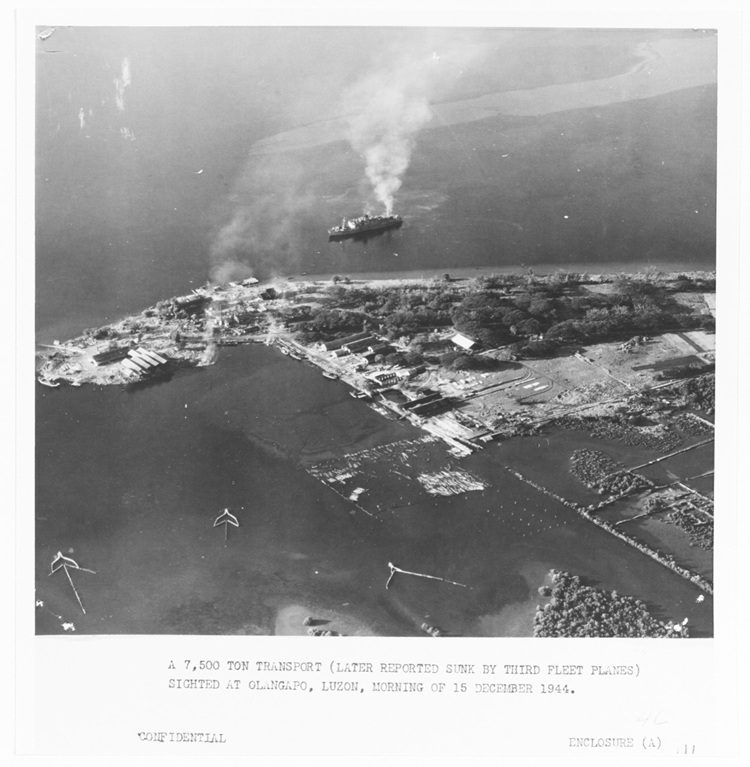
Aerial photo of the former U.S. Naval station, Olongapo, taken from a USS HANCOCK (CV-19) plane on 15 December 1944. Large ship is probably the S.S. ORYOKU MARU, sunk in Subic Bay by Third Fleet planes on 16 December. Naval History and Heritage Command. NH 95603.
Close to shore, Peck was recaptured. He was among one thousand other prisoners. They were packed onto a double tennis court and given one spoonful of uncooked rice a day. Peck and the other prisoners were then put on a train for Lingayen Gulf. The POWs, including Peck, were put on another ship, Enoura Maru, for Formosa [Taiwan], which was also bombed, killing many. A third ship, SS Brazil Maru, took Peck and the prisoners to Mogi, Japan. They arrived there, mostly naked, in wintertime. The men were given clothes and hobnailed boots, with no socks. Men’s feet froze. The Japanese took Peck to Mukden (now Shenyang) in Manchuria. Allied prisoners of war knew these ships as "hell ships" because of their conditions.
At Mukden, Peck found himself at a very isolated camp. Peck learned about the atomic bombing of Japan from POWs who worked in factories and had contact with Koreans and Manchurian civilians. On August 20, 1945, Russian troops arrived at Mukden and took control of the camp. After several days, a team of American airmen dropped into the camp and evacuated POWs based on medical need. Peck was with the second group of evacuees because he was suffering from diarrhea and malnutrition.
Peck arrived back in the U.S. on September 6, 1945. He was transferred from hospital to hospital on his way home. He ended up at Walter Reed Hospital in Washington, D.C., where his mother was living. After his release from the hospital, he went to a leave center in Santa Barbara, California. He then joined his wife, who was with her family in Spokane, Washington. In 1946, he was diagnosed with ulcerative colitis in Spokane and given six months leave from the Army.
During the Korean War, Lieutenant Colonel Peck was commanding officer of the 2d Battalion, 15th Infantry Regiment, 3d Infantry Division. He returned to the U.S. in May 1952 and was assigned to various regular duty stations. He and his wife moved to Madison, Wisconsin, in 1963. He served with the National Guard Advisory Group in Wisconsin from 1963 to 1966. He retired in 1966 as a colonel. He hosted a show on WHA-TV (later known as Wisconsin Public Television). He worked for the Dane County Food Program for the Aged. He and his wife volunteered at Independent Living and RSVP (Retired Senior Volunteer Program of Dane County).
Peck was a two-time recipient of the Silver Star for gallantry in action during World War II and the Korean War. He was also decorated during his military career with two Legion of Merit, two Purple Hearts, and two Combat Infantry Badges. Allen Peck died June 25, 1997, at eighty-seven years of age. He lies buried at Arlington National Cemetery, Arlington, Virginia.
Destiny seemingly did follow the West Point Class of 1936. Its graduates would distinguish themselves in American military annals. Among the forty-eight generals that came forth from this impressive class was Benjamin O. Davis Jr., the first African American general in the United States Air Force, and many who would hold prominent positions in America’s conflicts to come. Of the future colonels that emerged from that class of notables and answered the call of their times was Colonel Allen L. Peck.
Please click on the below image to listen to Peck's complete interview: