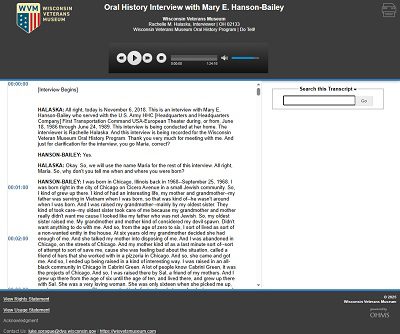
Mary “Maria” E. Hanson-Bailey
In recognition of Pride Month, we highlight interviews with two gay soldiers who served in the military before gay people could serve openly. Their experiences are a reminder of how policies changed making the military more inclusive.
On September 20, 2011, the Don’t Ask Don’t Tell (DADT) policy was repealed, allowing homosexual service members to serve openly for the first time without threat of judicial punishment. DADT was put into effect on February 28, 1994, and it allowed homosexual service members to serve as long as they remained in the closet. Under this policy more than 13,000 service members were discharged.
Before DADT the Uniform Code of Military Justice (UCMJ) explicitly banned homosexuals and other members of the LGBTQ+ community from serving in the United States Military. These policies reflected the laws of the time that criminalized behaviors that were considered gender deviant, such as same-sex relationships or wearing the clothing of the opposite sex.
Mary “Maria” E. Hanson-Bailey served as a Traffic Management Coordinator in the United States Army from 1985 to 1989 with the HHC, 1st Transportation Movement Control Agency, USAREUR at Camp King in Oberusel, Germany. Hanson-Bailey grew up in Chicago, Illinois, and Richland Center, Wisconsin. She joined the United States Army on June 18, 1986. She attended basic training in Fort Dix, New Jersey, and advanced individual training as a traffic coordinator at Fort Eustis, Virginia.
When she enlisted, she did not yet know that she was gay and came out while serving. At the time, she was unaware that she could be discharged for admitting to being gay. She notes that some people knew she was gay and was careful who she told.
Hanson-Bailey: “You know you had wonderful fun times, you had these amazing friends, you were out to your small group of people that understood you and got along with you. You cautiously you told people you knew. My colonel knew. My colonel accepted me. But you didn't tell everybody. And you kept it secret from many people. My captain didn't know. Other people didn't know. But--but we all--we all thought it would be fine if we just stayed low profile. And we all kind of were under the impression that, you know, it would be up to our commander to decide if we got kicked out.”
Despite being discreet, Hanson-Bailey found out from a friend that she was under investigation by the Criminal Investigation Division (CID).
Hanson-Bailey: “And he called me up and he said, 'Maria, you're part of the witch hunt. They've got pictures of you with another lieutenant.' And we were joking at the time, but I had put my hand over her mouth and kissed her over a fountain. She was straight. She’s completely innocent. She was just on vacation with us, and we were joking around. She ended up getting kicked out too, as a lesbian. Yeah. No innocent till proven guilty, right? But she--we all got pulled into the web. And so, I was afraid that Robin and Kimmy [Hanson-Bailey’s friends who were also gay] might get affected by it too. So, I decided to go to my commander at the time and just tell him.”
Given the rules at the time, her commander was unable to protect her but was able to get her an honorable discharge.
Hanson-Bailey: “My whole career was gone. Everything I dreamed of was gone. I was completely lost. And I just drank myself silly. It was the worst time of my entire life. I didn't know what to do with myself, I didn't know what I would do. I had no idea what my future held. I really couldn't even imagine a future at that time. And I was completely lost and confused. Everything I believed in had been tossed aside. And between November and January and being kicked out, I just, you know, I realized I had lost everything I held most dear.”
After leaving the Army, she moved to Madison and worked at a fast-food restaurant, then as a secretary and earned an associate degree in human service from Milwaukee Area Technical College. She has also advocated for gay rights, mental health, and victims of domestic violence: “I have chosen to be an advocate for all these years because I believe that the underdog deserves a voice.”
Hanson-Bailey reflects on the time when being openly gay could get someone kicked out of the military and how that has changed.
Hanson-Bailey: “I'm a generation of before the Don't Ask, Don't Tell. We were a generation that were kicked out, that didn't have options. We didn't even have the option of hiding. We were hunted like animals. We lost our careers. We lost our dreams. We lived in the shadows. And I think it's important to tell our story. And like so many of us, there was beauty and fun. I can remember the tea dances on Sundays, when we go to Frankfurt and dance in this beautiful Parisian dance party place in Oberusel—in--in--Frankfurt. And it was the most fun, and we were beautiful people, and we had the most gay time. And it was absolutely marvelous. Champagne flowed and we had fun. And we were fully alive. But then we had to walk back to the base and go back into hiding. But we were proud to serve, and we were good at what we did. We were good at our jobs. And we deserved the respect of being soldiers that were good at our jobs. But we had to do it in hiding. And yeah, I think it is cool that today soldiers don't have to be in hiding. I would do anything to step back fifty years and be able to be a soldier to proudly be gay and proudly serve. That would be cool. That would be a moment. And I can’t ever have that. But that would be cool.”
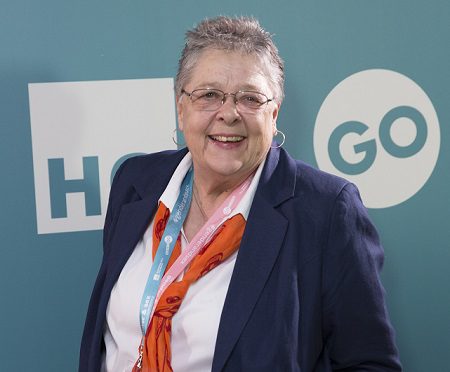
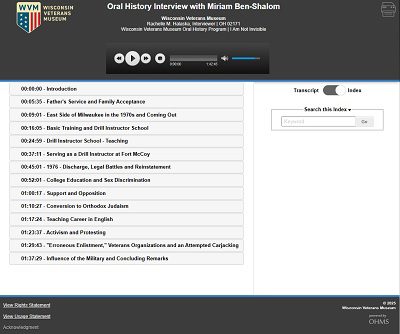
Miram Ben-Shalom
In 1974, Miram Ben-Shalom was a single mother living in Milwaukee. She joined the United States Army Reserve to earn extra income. She served as a drill sergeant with the 5091st Reception Battalion and trained drill instructors at the Leadership Academy with the 84th Training Division from 1974 until 1976, when she was discharged for being a lesbian. She became the first openly gay person to re-enlist and served from 1987 until 1990 after successfully challenging her discharge in court.
Ben-Shalom says she was given the opportunity to lie about her sexuality to remain in the military, but she refused.
Ben-Shalom: “I can't change what I am. They wanted me to go see a military psychologist, and I asked if it was a direct order and they said, ‘No, but we think you should.’ And I said, ‘Well, I'm not sick, I'm a lesbian’ you know—the Packers just did something. And it was wrong. I think as long as you know what the rules are, and you abide by rule and regulation. That's fine. Okay? And it was wrong. I had--I was--I have never been accused of misconduct. It's important for people to understand that. Even the Army admitted that I never even ogled--this is a direct quote from my court case, that I never ogled or eyed up any female soldier, ever. Not even once. I never did. I was never accused of it. And that's why I decided to fight back because, I mean, we see gay people serving now just fine and there's no problem. Because sexual orientation is immutable. You can't change it. It's part and parcel of what the wholeness of a human being is. And I just thought that discrimination is wrong. It's not right. There was no logic behind it.”
Ben-Shalom says she has heard that her case resulted in the military’s Don’t Ask, Don’t Tell policy. She says she doesn’t know if this is true, but she was critical of the policy.
Ben-Shalom: “And but Don't Ask, Don't Tell was draconian, simply because okay, you serve with people, ‘Hey, you want to go to a show, you want to do this, you want to do that?’ You have to lie about your girlfriend. Okay I'll speak from a woman’s, a lesbian's perspective, and say you have a boyfriend. You can't tell anybody anything. So Don't Ask, Don't Tell was draconian because people like to talk. They communicate. But if you came and said, ‘Oh yeah, my girlfriend and I are going to the Redwood Forest,’ or whatever, bam, out you go. It was also dependent on commanders' own mindsets and biases. So you had some commanders who really didn't give a damn and "Fine, I don't care." And then you had fundamentalist Christian ones who, you know, went after lesbians and gay people with bear traps and fangs. I think the best day of my life was to be present when President Obama signed the end of the ban and allowed gay people to serve, he hugged me.”
For the complete interview, please click on their name or interview image below:
Mary E. Hanson-Bailey (OH2133)