

August 16, 2025, is National Airborne Day. In celebration, the Wisconsin Veterans Museum would like to honor the story of Thomas “Tom” J. Lucas, who served as a paratrooper in the United States Army in World War II and the Korean War, including participating in a combat jump on D-Day, one of five combat jumps during his military career. Lucas's jump on D-Day forms a part of the new exhibit D-Day, which debuted at the Wisconsin Veterans Museum on July 18, 2025. The exhibit pairs paintings by renowned mural artist Keith Rocco with the stories of the veterans who were there on the ground in France. D-Day is on view in the Changing Gallery during our museum open hours, Tuesday-Saturday 10 am to 5 pm and Sunday 12 pm to 5 pm. Join us in honoring the service of Thomas J. Lucas from 1942 to 1951 in honor of National Airborne Day.
Lucas made a deal with the draft board and entered service in February 1942 from Madison, Wisconsin, and initially reported to Fort Sheridan, Illinois. He attended Basic Training at Fort Hood, Texas. One morning, a few months into his time in Texas, a sergeant asked for applications for soldiers interested in airborne training. Lucas was thrilled to have a new opportunity and signed up immediately. In August of 1942, the Army transferred Lucas to Fort Benning, Georgia, where he underwent airborne training. The Army assigned Lucas to the C Company, 504th Parachute Infantry Regiment, 101st Airborne Division. In September 1943, Lucas then performed his first combat jump as part of the invasion of Italy:
LUCAS: Yeah, combat jump, yeah. We jumped at a place called, I think it-- Avellino or something like that. It was where the highways were coming down to the, to the beach and we were supposed to hold or blow a bridge. It was a fairly, you know, rugged jump. It was mountain country, pretty rugged. When you jump low like that, you don't have time to worry about it. We held the unit for, I think, about ten days or two weeks, took some casualties. Of course the Germans wanted to take the bridge and blow it, you know. So when they got on the beach, they got reinforcements were cleared to come up and relieve us. That's when I got shot the first time, and sent me to a hospital.
After the jump and during the subsequent battle, Lucas suffered a shrapnel wound that forced him to take some time at the aid station to recover while in Italy. In December 1944, the unit moved to Nottingham, England. There, the Army placed them in the newly created 2nd Battalion, 508th Parachute Infantry Regiment, and the unit began to train for their next mission. While in England, Lucas trained as a pathfinder, meaning that he was to be one of the first soldiers to jump in, and would set up beacons to instruct aircraft on where to make further deliveries and personnel drops. He served in the role early on June 6, 1944, when he jumped into D-Day miles beyond Utah Beachhead:
LUCAS: Our mission was, I think it was with the 506th [508th] around Sainte-Mère-Église, south of Sainte-Mère-Église, in that area. We, the pathfinders landed up alright, fairly well, everybody was off but we got ourselves oriented. When the other troops came in, they dropped some of them in the swamps. Before the invasion, the photographs showed that this was just a swamp but between the planning and the actual job, the Germans raised the water levels and it was sixteen feet deep. Quite a few of our men in our unit drowned in the swamps. So we took casualties that way. We really, they were spread all over the country. It just did not go as good as some of the other units. So we functioned independently. You had your clicker, little clicker they gave you, you click it and somebody else hears you they click back. That's when you find out that a German rifle, when he opens the bolt and closes it, sounds just like that clicker. So, take a couple of casualties, you learn. You don't click too often. You just move around and you don't do anything aggressive. You just try to keep a low silhouette. Occasionally you meet somebody else and you got three, you got four, you got five. Some of the units were fourteen days later, they were still working independently, groups of fifteen, twenty.
Lucas was part of a group of about fifteen pathfinders tasked with holding the position south of Sainte-Mère-Église. They went around the surrounding towns, cutting German communication wires and getting into minor firefights. After eight days, they had made good headway and were linking up with the invasion forces fighting on the Utah Beachhead. After the conclusion of much of the fighting at Normandy, Lucas and his unit returned to Nottingham for further training. His next and final jump in World War II would be as a part of Operation Market Garden in the Netherlands:
LUCAS: This was Sunday afternoon, September 17th. Nice, bright, sunny day. We went into Holland. We landed outside of Nijmegen, right near the German-Holland border. The Waal and Maas Rivers go down and separate the two. We landed, there were German troops and we landed right in the middle of German troops. No large force, but there was gunfire. Then we, we assembled. I came down right next to a well and a farmhouse, right next to a well and I was just able to get some cover because it was wide open Holland, pretty flat. I heard somebody in the house yell, ‘Get in here.’
While attempting to get back to his unit fighting on the bridge, a German soldier shooting from a hole in the ground wounded Lucas. Lucas woke up in that same hole, severely wounded, next to a dead German soldier and a dead cow. He slowly made his way back to Reims, France, where he recovered in a hospital. After spending time in many military hospitals overseas and in the United States, the Army cleared Lucas to return to duty and assigned him to work out of Fort Benning, Georgia, doing war bonds work. Eventually, after a practice jump ended in a rough landing, Lucas was discharged from the U.S. Army with four Purple Hearts.
Lucas returned to Wisconsin and returned to school at the University of Wisconsin-Madison, studying social work and joined ROTC. He finished school and got married, but remained in the U.S. Army Reserves. In February 1950, the military called up Lucas to ship out to Korea just days before the birth of his first daughter. He went to Camp Stoneman, California, where the Army assigned him to the 187th Regimental Combat Team, Parachute Unit in Taegu, Korea. While in Korea, he completed two more combat jumps, the first being at Sukchon on October 21, 1950:
LUCAS: The one in Sukchon we jumped--that one was 1400 hours which would be two o’clock in the morning, you know. The objective there, there were two cities; Sunchon and Sukchon and it was just east of Pyongyang It was MacArthur's intention the Koreans were going north and taking American troops. His idea was to put a noose around 'em by dropping the Airborne units in. We had two different drop zones; one unit would stick to high ground and the other would take the railroad stations. Unfortunately, the North Koreans got through and crossed the Yalu River and we hit the engagements of the remaining North Korean troops. It generated some real serious fighting and lots of casualties. It's all together different kind of fighting that we had in Europe. The North Koreans were real aggressive enemy. A lot of the Chinese with 'em. They did a lot of frontal attacks, repeated attacks, repeated attacks. The Sukchon one, we had some movement of assignments of a couple of companies to a city south, Opari and we were in conflict with two platoons and we were involved with a battalion of North Koreans. We lost about, we were overrun and lost about ninety men. So we generated a lot of casualties. Now that includes wounded as well as civilians killed.
After the fighting at Sukchon, Lucas was re-assigned to be a forward observer. He credits his survival working this very dangerous position to his infantryman training. He describes thinking like an infantryman, judging and observing situations in a mechanical manner. Lucas would go on to complete his fifth and final combat jump as part of Operation Tomahawk in Musan-ni, Korea, on March 23, 1951. He finished out his term of service serving as an executive officer in a medical company in Korea, a position assigned due to his education and experience in social work.
Lucas was sent home from Korea in February 1953. He was officially discharged from the U.S. Army and began life as a civilian. Lucas lived in Madison, where he worked for the state of Wisconsin until his retirement. The story of Lucas's airborne experiences is extraordinary. His peers recognized him as such, and upon his passing in 2021, active duty members of his former division, the 82nd Airborne Division, served as the honor guard at his funeral in Madison.
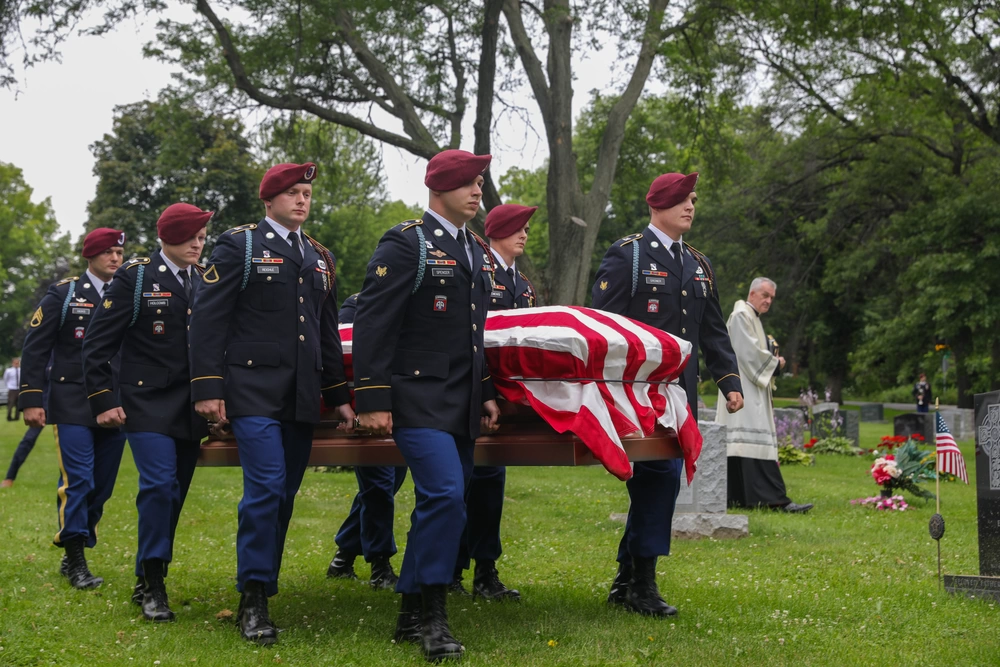
Members of the 82nd Airborne Division: Thomas Lucas's honor guard detail at his funeral on July 21, 2021, in Madison, Wisconsin. The appearance of U.S. Department of Defense (DoD) visual information does not imply or constitute DoD endorsement. 6579044. Public domain.
Lucas, however, never thought of himself in extraordinary terms; he instead emphasized:
“The only heroes are those soldiers that didn't make it back home. The rest of us are referred to as the 'lucky ones.'" – Thomas J. Lucas.
We have three interviews with Thomas J. Lucas, please click on the image or link below to watch or read the complete interview:

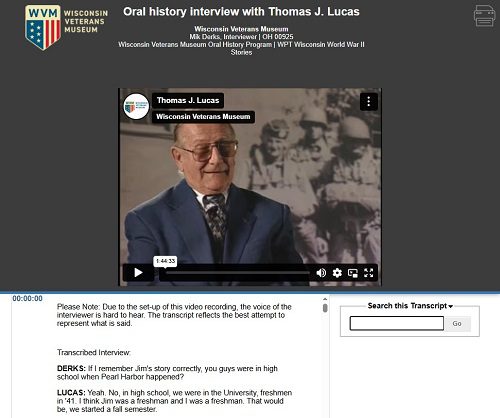
For the interview that focuses Thomas J. Lucas' Korean War service click here (WVM OH1041).