
The Wisconsin Veterans Museum name may give the impression of a fixed place appealing to a captive audience. The work the museum staff accomplishes, however, reaches beyond the confines of the physical museum space in Madison, Wisconsin to offices in our State Capitol Building, exhibits at presidential libraries, historic markers at national battlefields, training videos for our troops, and performances at concert halls.
As a service to state legislators, the museum staff provides recommendations for historic images to decorate legislative offices. Earlier this year, State Senator Chris Kapenga (R-Delafield) and his staff visited with WVM’s curator of exhibits, Greg Krueger, to view the available content. Ultimately, the senator chose nine images which included shots of Arlington National Cemetery, World War II sea battles, and candids from Vietnam. Krueger assisted with production and installation at Senator Kapenga’s office in the State Capitol Building.

Dressed mannequin at the Lyndon B. Johnson Presidential Library with artifacts loaned from WVM. Photo courtesy of the Lyndon B. Johnson Presidential Library in Austin, Texas.
From the State Capitol Building to the Lyndon B. Johnson Presidential Library in Austin, Texas objects from WVM made appearances. In September of 2023 WVM’s former registrar, now curatorial supervisor, Sarah Kapellush, received an inquiry about several objects from the Vietnam Era that the library was interested in borrowing for their upcoming exhibit, Ain’t No Daylight in Vietnam: March 1968. Because of the care WVM staff takes to document our collections and make them accessible for audiences outside the museum proper, the Lyndon B. Johnson Presidential Library staff were able to easily locate the items relevant to their exhibit. Kapellush performed many regular tasks for this loan like selecting objects suitable for an exhibit, presenting the artifacts to the collection committee for approval, preparing them for travel and display, and packing and prepping items for an exhibit. Kapellush says where her duties diverged from the norm were that, “We do very few loans overall and this was one of the larger (perhaps the largest) loans we’ve approved by object count.”
Well-known for our expertise in Civil War history, WVM reference archivist, Russ Horton, received a call from staff at Petersburg National Battlefield in Virginia for help in identifying soldiers buried at Poplar Grove National Cemetery. Several of the soldiers are identified as being from the 38th Wisconsin Infantry and are noted as being Native American. The Petersburg staff were hoping we could help determine tribal affiliations. Using WVM’s archives and his own personal research Horton found several of the soldiers were from the Menominee Nation and referred Petersburg to the Menominee Nation for more information. The Menominee Nation warriors at rest in Virginia are now properly recognized.
Collaborating with the museum’s military contacts brought first-person accounts of battle to the training classroom. In November 2024, Captain Florian Waitl, Command Historian, Wisconsin National Guard, contacted WVM’s oral historian, Luke Sprague, about a documentary on the 32nd Infantry Division and the Battle of Buna he was working on with the Army University Press for classroom use.
Sprague ensured the producers had access to the cache of interviews from World War II veterans of the 32nd Infantry Division in the museum collection. Sprague says this work did not differ from his regular duties; and yet his actions led the video producers to acknowledge the importance of the oral histories in shaping the narrative of “The 32nd Infantry Division’s Nightmare: The Battle of Buna.” Sprague did acknowledge that the richness the oral history content, “provides more than one way of remembering a shared experience, and this in turn makes the retelling of those stories more robust.” The video is posted on the YouTube channel of Army University Press.
From the digital screen to live stage performances, content from the Wisconsin Veterans Museum has inspired local creatives to tell the stories of Wisconsin veterans through song. Through research in the museum archives, Ken Fitzsimmons, founding member of The Kissers and Mobilize the Poets, retells the stories of three Wisconsin Veterans in their second “rock ‘n roll” history show, The Foe and the Fallen. The Kissers first worked with content from the museum in their 2018 sold-out show The Greatest War: World War One, Wisconsin, and Why It Still Matters.
At a performance at the Barrymore Theatre in Madison this past Veterans Day, concert goers saw images from the museum collection and heard music inspired by the stories of World War I veterans Arthur Cantwell, John James Haddock, and Helen Bulovsky. Cantwell, of Shawano, barely escaped the sinking of the USS Tuscania by a U-boat. Haddock, of Milwaukee, lied about his age so he could enlist; Helen Bulovsky, of Madison, on the day she ships off to be a nurse in France called herself the "happiest mortal in town." These accounts from ordinary people of an extrordinary time in our nation's history that are preserved at the Wisconsin Veterans Museum allowed Fitzsimmons develop the show that celebrates the lives of everyday Wisconsinites.
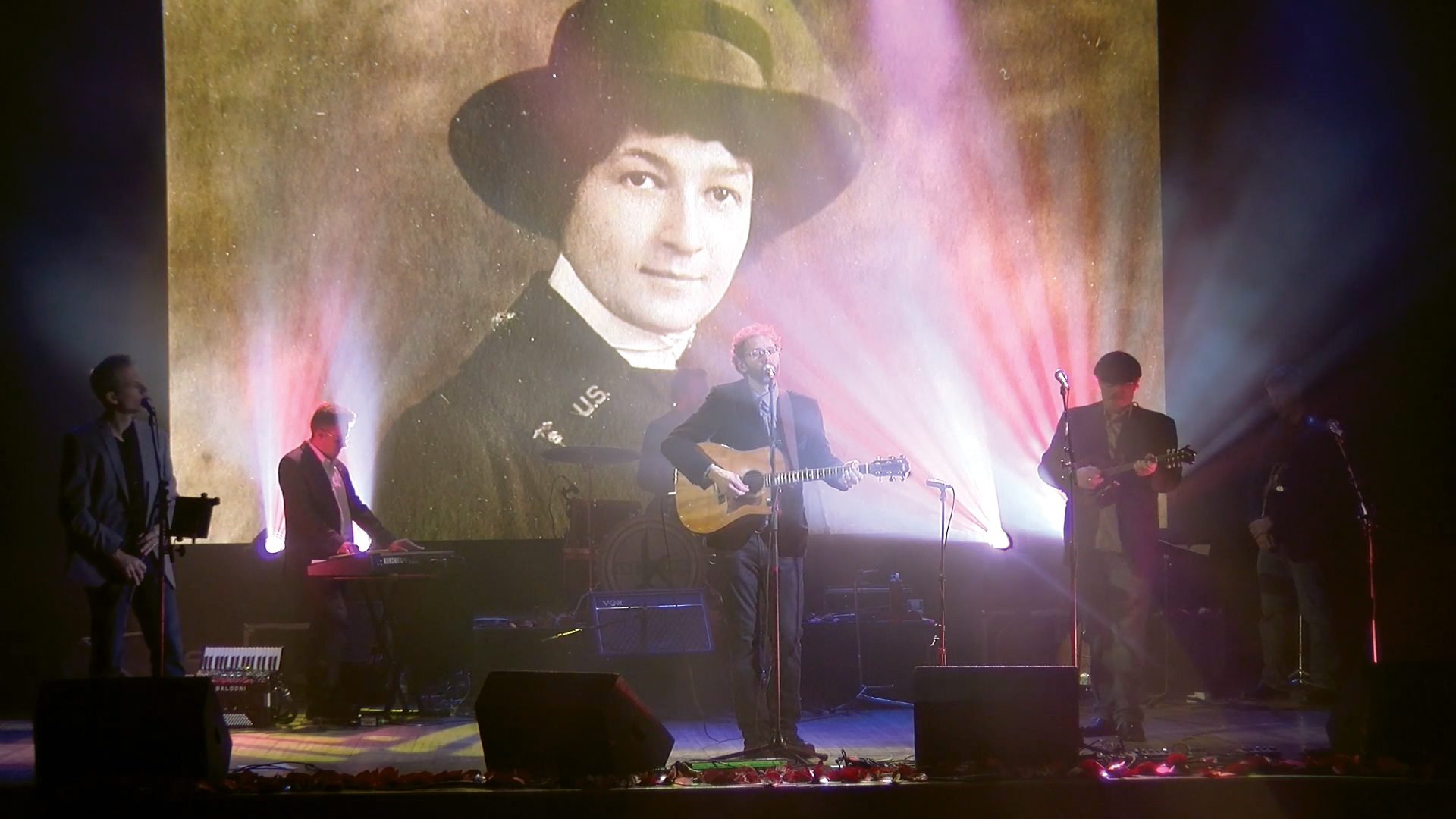
An image of World War I nurse Helen Bulovsky from the Wisconsin Veterans Museum Collection provides a backdrop for the rock and roll history show, The Greatest War, performed by The Kissers. Photo courtesy of Ken Fitzsimmons.
History is shared by all of us and museums hold collections in public trust. Sharing the Wisconsin Veterans Museum collection with appropriate institutions and organizations across the state and nation shows how Wisconsin Was There in the narrative of our nation and why It Still Matters.
"Other Duties As Assigned" was written by Jennifer Stevenson, Marketing Manager at the Wisconsin Veterans Museum. Article adapted for the web by James Kovaleski, Marketing Specialist. This post is from an article first published in the Winter 2025-26 issue of The Bugle.