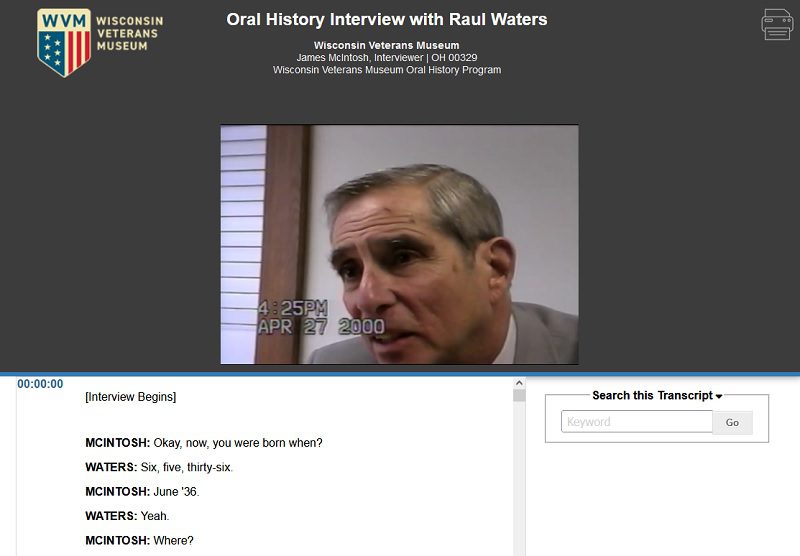
Photo of Raul Waters from his April 27, 2000, interview.
Raul Waters was born in 1936 in Cuba before immigrating to the United States as a child in 1945. Initially in Tampa, Florida, Waters grew up in Detroit, Michigan, then moved to Milwaukee, Wisconsin, for his surgical residency.
When the Army drafted Waters in May 1966, he had two months left in his medical residency at Marquette University Medical School, Wisconsin. The Army assigned him initially to a hospital in Fort Knox, Kentucky, as a urologist for seven months. While there, the senior Army urologist mentored him.
Following that, the Army sent Waters to Fort Sam Houston, Texas, for training. While at Fort Sam in July 1967, Waters received his orders to Vietnam. En route to Vietnam, he received training back at Fort Knox from an infantry unit on weapons and the particulars of Vietnam. After resettling his family in Detroit, Waters flew to Vietnam via San Francisco and then McChord Air Force Base.
Once in the country, the Army assigned Waters to the 67th Evacuation Hospital in Qui Nhon, Vietnam, supporting the 7th Cavalry and the 4th Infantry Division, where Waters was a surgeon. In his interview, Waters relates types of injuries, medical procedures, and the experience of a surgeon who operated on combat wounds in Vietnam. He details the stresses of working for three days straight. His replacement arrived a little early, allowing him to leave Vietnam, and the Army discharged him soon after from Fort Lewis, Washington.
After the war, Waters accepted a position as Assistant Professor of Surgery at Marquette University Medical School. He then took a position in Madison, Wisconsin, at the Dean Clinic, where he worked for thirty-seven years and would become Clinical Professor of Surgery for the University of Wisconsin-Madison.
Dr. Waters passed away in 2014; here he is, in his own words, describing his experiences as a surgeon at the 67th Evac Hospital in Qui Nhon from 1967 to 1968.
Waters talking about receiving combat casualties:
WATERS: Well, I volunteered. Sure.
INTERVIEWER: There wasn't enough urology to keep you busy full-time.
WATERS: Yeah, no, I just thought that was the right thing to do and everybody needed help. So, it was worthwhile.
INTERVIEWER: You didn't have to leave the hospital, everything came to you, is that right?
WATERS: Yes, well, I'll go into that later on. I'll tell you some interesting stories about that.
INTERVIEWER: Sure, that's what I want.
WATERS: But even though we were designated an evac hospital, we were we were really a surgical hospital because of the helicopter. Our casualties came directly from the field.
INTERVIEWER: In essence it was a big M.A.S.H. hospital.
WATERS: That's what it was.
INTERVIEWER: Yeah, I mean a specialized M.A.S.H. hospital, right.
WATERS: That's what it was. I mean, we took casualties directly from wherever--
INTERVIEWER: Within minutes.
WATERS: Twenty minutes was the latest.
On the exhaustion of surgical teams:
WATERS: But it was really nice to get those days off where we'd just kinda goofed off because, you know, sometimes we would go two, three days without sleep. You know, you know how it is, they just kept coming, just coming, you know.
INTERVIEWER: Pretty soon you're just sorta marching through without thinking.
WATERS: That's true.
INTERVIEWER: That's when it's danger time.
WATERS: Boy, it was, it was really, really, sometimes you were so beat.
INTERVIEWER: I know it. And you didn't think much and you just--
WATERS: You just did it.
INTERVIEWER: And you should have been, you know, but you can't. Wow. So, when you got there, you had something to do and you just sort of had no schedule, just get up in the morning and get over there and start work or what?
WATERS: Well, we tried to have schedules. What we did is, two surgeons were the guys on call.
INTERVIEWER: Who would receive the incoming?
WATERS: Who received everything.
INTERVIEWER: Oh.
WATERS: In other words, these two guys did the triage and operated, until they were overwhelmed. Then the next two guys up would come in and relieve. Not relieve them but just pick up the slack. And then the next two guys. You know--
INTERVIEWER: Constant rotation, so--
WATERS: Yeah. So on a given, you may go twenty-four hours and it's just the two of you take care of everything.
INTERVIEWER: Because it wasn't so busy.
WATERS: It wasn't so bad. But most of the time there'd be about four or five of us going all the time.
Army resupplying the PX with alcohol, but no sutures for surgery:
INTERVIEWER: Did you have access to alcohol?
WATERS: Yes. I'll tell you a story.
INTERVIEWER: Tell me a story.
WATERS: We were running short of supplies once during the Tet Offensive, and the supplies weren't getting in as rapidly as they normally did. And I must say we were always well-supplied, but there was a period of time for about a week or two where we weren't getting anything. And we were running a little short of suture. And we just had enough suture and somehow the Army got through and stocked the PX with booze. But we didn't get our suture. [laughs] And that's a true story. The booze got through and--
INTERVIEWER: You should have called a near hospital and traded them.
WATERS: Oh, we did a lot of that. I mean we did a lot of that. But we were okay, but we were running low. But the booze got through and the suture came next. [laughs]
Triaging casualties at the hospital:
WATERS: When one of the-- when the C-130 landed and when we got more than-- usually it was the helicopters that brought in the wounded three or four at a time, which is fairly easy to deal with.
INTERVIEWER: Sure.
WATERS: But when a C-130 came in with all kinds of injuries, then you literally, you had to move very rapidly with that.
INTERVIEWER: Yeah, I mean there might be sixty guys.
WATERS: Might be yeah, thirty to sixty, depending, thirty to sixty.
INTERVIEWER: Just don't know where to turn with that.
WATERS: Right. And so, the decision had to be pretty fast because we only had about four operating rooms. And so, we had to move, and the ones needed surgery right away; that was the beauty of it, we could get somebody in the operating room within minutes. Just literally within minutes. We could move right along. We had everything set up, so it was a straight shot.
INTERVIEWER: Straight shot and a--
WATERS: Straight shot. You went from pre-op where we got you stabilized, went right to X-ray where we got a KUB just about on everybody.
My duty.
WATERS: You know, obviously I didn't volunteer for this, but I don't regret it.
INTERVIEWER: Regret it?
WATERS: I never forget; I mean I really felt I needed to do this.
INTERVIEWER: Me too.
WATERS: My duty. I never regretted that. No grudges.
INTERVIEWER: I never did. And I learned so much that I never would have learned otherwise.
WATERS: I agree. I learned a tremendous amount. It was wonderful.
That was tough.
WATERS: We were pretty well protected. We got shelled once in while, mortar rounds, that came in and stuff like that. But--
INTERVIEWER: Yeah, we didn't talk about that. You weren't really worried about it though.
WATERS: I really wasn't worried. Because, I think the Vietnamese, the Viet Cong knew that we were taking care of their prisoners. And we did. So, I don't think they made an effort to hit the hospital. But they did hit the facilities of the engineering company got hit and they were right next to us.
INTERVIEWER: With what? Mortars?
WATERS: Mortars, yeah. Things like that. But the saddest thing that I recall is during one of those pushes that we had a lot of-- Pleiku was taking a lot of casualties. And they asked for help from us. So, we sent a contingency of, I can't tell you the number of nurses, but it was three or four nurses, maybe five nurses, and, one neurosurgeon, a couple of general surgeons, and an orthopod, I think. They all went up to Pleiku to help out.
INTERVIEWER: With help South Vietnamese soldiers, wounded?
WATERS: Yes, I mean, but it was mostly Americans being treated, you know.
INTERVIEWER: Oh.
WATERS: Yeah, Pleiku had a hospital and they were taking casualties up there.
INTERVIEWER: Oh, I see.
WATERS: It was an American hospital. So that we sent--
INTERVIEWER: A team up there.
WATERS: -- this group of personnel to help them. And they did their job and on the way home something unusual happened. The nurses, everybody was going to fly home on one plane. And, but the doctors were asked to stay on to help out a little longer, a day extra. So, the nurses took off and were going to land back in our place, which was about a hundred miles away, well, maybe sixty. And on the way in a big tropical storm came in. And to make a long story short, the plane ran into a mountain.
INTERVIEWER: Oh my gosh.
WATERS: And they--
INTERVIEWER: Lost 'em all.
WATERS: Lost all.
INTERVIEWER: Oh my. That was a good chunk of your nurses.
WATERS: That was so sad. That was the toughest part of--
INTERVIEWER: I bet. Boy, that put everybody in tears.
WATERS: Well, and when I went back to, I visited Washington D.C and I made a point to go to the wall. That was--
INTERVIEWER: Did you find some of their names? Yeah, tough.
WATERS: Yeah.
INTERVIEWER: That's tough.
WATERS: That was tough.
Click here or on the image below to view the full April 27, 2000, interview between the urologists Dr. James McIntosh and Dr. Raul Waters.