

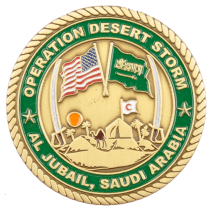
Navy Fleet Hospital 15 challenge coin owned by Oreck (V2007.57.35)

This British two-tone Disruptive Pattern Material (DPM) bush hat was acquired through trade with a doctor at a nearby Collective Protection (COLPRO) field hospital. It is shown along with a French Ration de Combat and Australian Combat Ration Pack (CRP) Oreck traded for while in Kuwait City. V2007.57.2, V2008.78.10, V2008.78.11
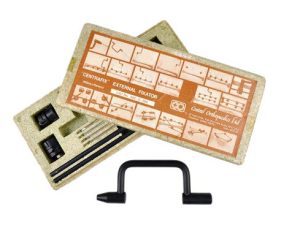
While in Saudi Arabia, FH15 traded medical supplies with a British hospital for this much-needed external fixator. Oreck brought it home as a souvenir. V2004.49.5
Over thirty years ago, the U.S. Navy Fleet Hospital 15 deployed to the Persian Gulf in support of Operation Desert Storm, arriving just as the ground war began. Within days of their arrival, the modular 500 bed facility located near Al Jubail, Saudi Arabia was assembled and ready to provide land-based medical and surgical care for the U.S. Marine Corps. Among the 940 people sent to run the self-contained facility was Captain Steven L. Oreck, a career medical officer in the United States Naval Reserve who specialized in orthopedic surgery.
Oreck was born in New York City, and was raised there and in New Orleans, Louisiana before entering service in December 1969 while attending the Massachusetts Institute of Technology (MIT). Following his graduation in 1970, Oreck reported for active duty in July and was commissioned as an intelligence officer through the Aviation Officer Candidate School at Naval Air Station Pensacola in November. After release from active duty in 1973, he returned to MIT for graduate work in chemical engineering followed by Louisiana State University for medical school. After receiving his MD in 1979 Oreck transferred to the Navy Medical Corps and was serving as chief of orthopedics at a field hospital in New Jersey when Kuwait was invaded in August 1990.
At that point, Oreck was told it was not a question of if, but rather when he would be called up. The logistics of moving all the necessary hospital equipment—including medical supplies, food, and the structure itself—delayed his deployment for several months.
In the first of two oral history interviews Oreck completed with the Wisconsin Veterans Museum, he explained that after their arrival, “…the equipment was there and we just sort of fell on the equipment…[it] is in all of these boxes, these steel containers, and then you go ahead and open them up and build a hospital…it’s got six OR beds and eighty ICU beds and 420 regular beds…It was all modular like Legos.”
He went on to explain, “The way these things were designed is you’d open them up out of the can, and the only thing you need to get going was water and fuel and blood. Other than that, you had enough medical supplies and food and everything to run this for the 950 people of the crew plus 500 patients for sixty days. It was all prepackaged.”
Over the next month, Fleet Hospital 15 treated about 85% of the marines that were wounded as well as U.S. soldiers and airmen and foreign servicemembers from England, France, and Senegal. After the ground war ended in February and other U.S. Navy medical facilities covered Saudi Arabia, Oreck was asked to stay on as doctor for the Explosive Ordnance Disposal (EOD) group in Kuwait City. The British, American and Australian EOD dive team was charged with removing unexploded ordnance and mines from the harbor, and due to the inherent hazards of their work, required continued access to medical care.
It was during this period Oreck traded for some of his more interesting keepsakes from his tour, including a British bush hat and Australian and French rations, the latter the result of him being the only naval officer in Kuwait who spoke French. Perhaps the most unusual souvenir is an external fixator kit used to stabilize broken bones that he traded medical equipment for with a British hospital while in Saudi Arabia.
After his return stateside at the end of April, Oreck’s civilian career as an orthopedic surgeon led him to Madison, where he went on to work as a professor of orthopedics and plastic surgery at the University of Wisconsin School of Medicine until his retirement in 2008. He also remained in the Naval Reserve for another 16 years, amongst other assignments serving as regimental surgeon for the 23rd Marine Regiment and as a medical watch officer at the Combat Operations Center at Headquarters, U.S. Marine Corps in Washington, D.C. during Operation Iraqi Freedom. Oreck retired as a captain on January 1, 2007.
Afterward, Oreck earned his M.A. in History at the University of Wisconsin-Madison and was pursuing his doctorate, writing his dissertation on the history of military medicine when he passed away on August 11, 2019. We are grateful for all Oreck’s many contributions to the Wisconsin Veterans Museum.
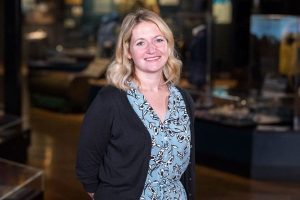
The Desert Storm Doc: Steven L. Oreck was written by Andrea Hoffman, Collections Manager at the Wisconsin Veterans Museum.
The article was first published in the Spring 2021 issue of The Bugle.