
Women’s Army Corps (WAC) 1943 and the 6888th Central Postal Directory Battalion
World War II, the global conflict that saw United States fighting forces engaged around the world, created a need for using all citizens of the United States during the war. The U.S. military created women’s auxiliary units starting in 1942 to take the supply and office jobs to send more men to the front. Though followed by rumors of unladylike behavior, women signed up to serve in the Women’s Army Auxiliary Corps, which became the Women’s Army Corps (WAC) in 1943. This included black women, who experienced segregation like their male peers. First Lady Eleanor Roosevelt and Mary McLeod Bethune, a black educator and activist, pushed for black women to be admitted to the WAC. Some African Americans saw this as a chance to prove their worth as citizens themselves.
The 6888th Central Postal Directory Battalion (also known as the “Six Triple Eight”) was a mostly black battalion of the WAC. They are credited with resolving a massive backlog of an estimated 17 million items of troop mail in England and France during World War II.

WACs at Fort Des Moines, IA Martha Blakeney Hodges Special Collections and University Archives, UNCG University Libraries
Wisconsin Was There: Anna Mae Robertson of the 6888th Central Postal Directory Battalion
Wisconsin is home to one of the two last surviving members of this battalion, Anna Mae Wilson Roberston. Born in 1924, her mother raised her and her brother in Arkansas. Anna Mae’s mother died at the start of the war and when her brother enlisted in the navy, Anna Mae signed up with a friend to join the army. Her friend didn’t pass the physical and she found herself entering service on her own. She started her training at Fort Des Moines, Iowa, which had been a key training ground for black soldiers and officers during World War I. For World War II, Fort Des Moines became the training location for the WAC, both white and black though segregated. Anna Mae recalls meeting new friends in her unit as they trained for service who would later impact her life. Her first assignment was as a nurse’s aide in the hospital at Camp Breckinridge in Kentucky. From that assignment, she was then directed to Shanks, New York to ship out with the rest of the women that made up the 6888th to England.
In her oral history, when asked how her treatment was as a female in the army, Roberston recalled, “They were nice. I never had any problems with any of them. … My major in my group that I was with the ladies, it was Major Adams [Major Charity Adams]. But I never had enough trouble with any of them.” Robertson continues to recount how going to England across the ocean made her feel like a different person. She didn’t find army life too difficult. She didn’t mind that that the army trained them, prepared supplies for them, told them when and where to go. Since her mother had passed away, Robertson felt the army gave her a place and it took care of her. She was able to keep in touch with her brother in the navy and tell him about her ocean crossing.

Anna Mae Robertson Milwaukee, Wisconsin 688th Central Postal Delivery Battalion Women's Army Corps 1943-46 Photo by Mr. Gene Russell
No Mail, Low Morale
The black WACs arrived in Glasgow, Scotland and were shipped by train to Birmingham, England to tackle the undelivered mail. The 6888th was organized on March 12, 1945 and most were assigned to postal clerk duty. They were tasked with sorting through the backlog to get letters to the men at the front, understanding it would boost morale. Their motto became “no mail, low morale.” The battalion organized themselves to work in three shifts, 24 hours a day, seven days a week, finishing a supposed six-month task in three. Robertson took her job in stride, doing what was asked of her. She recalls their downtime entertainment was under the purview of a special officer including dances. She was asked about living quarters in her oral history. “Oh yeah, we lived in schools,” she recalled. “There were so many of us to house, you know. So we needed a lot of room. We lived in schools, but they had colored all of the windows because of the war. You see, the war was somewhat practically over by the time we got over there, but the painted windows and things were still up.”
After the mail was sorted in England, the 6888th was sent to Rouen, France to deal with more letters, with the final destination in Paris, at which time the group had shrunk from 855 to 300. Robertson applied to return home soon after the war in Europe ended after her work in England and remembers, “I didn’t come back as a group like I went over because there wasn’t many of us being discharged at the same time. So, I came back on a smaller ship, but everything went fine.”
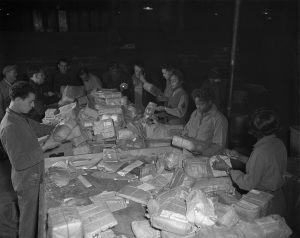
Photograph of the 6888th Central Postal Directory Battalion in Paris, France sorting packages. November 7, 1945. National Archives NAID: 175539203
Robertson was proud she learned how not to get seasick on both ocean voyages. After returning to the U.S. Robertson headed to an aunt’s place in Detroit but found herself visiting the friends she had made in the army. She came to Milwaukee to attend the wedding of Evelyn Ross’s sister, Margaret and stayed to work in the city. She met and married John Robertson, who was also a veteran, worked for the VA hospital in Milwaukee, started her family of eight, and then returned to hospital work as the children grew. Her children were able to attend college and also worked in medical professions. You can read more about her experiences in the interview transcript pdf.
75 Years Later: Getting Well-deserved Recognition
Just in the past 15 years, the 6888th has been getting the recognition it deserves for their efforts for morale overseas. In 2022, President Biden signed a bipartisan bill that awarded the battalion the Congressional Gold Medal. In December 2024, Netflix will release the Tyler Perry film, The Six Triple Eight, starring Kerry Washington as Charity Adams. Perry based it on the 2019 WWII History article by Kevin Hymel.
Video with no audio of the 6888th Central Postal Directory Battalion at work. United States Army, Public domain, via Wikimedia Commons

The "6888th Central Postal Directory Battalion" article was written by Jennifer Van Haaften, Wisconsin Veterans Museum Assistant Director.