
The Malmedy Massacre was a German war crime committed by soldiers of the Waffen-SS on 17 December 1944 at the Baugnez crossroads near the city of Malmedy, Belgium, during the Battle of the Bulge (16 December 1944 – 25 January 1945). Soldiers of Kampfgruppe Peiper shot and killed 84 unarmed U.S. prisoners of war. A few survived including Sergeant Henry "Roy" Zach of Burnett County, Wisconsin. This is his story of survival taken from an interview with the Wisconsin Veterans Museum in 1999.
This December marks the 80th anniversary of the Battle of the Bulge, also known as the Ardennes Offensive. Germany’s Adolf Hitler launched the offensive to try and stave off defeat on Germany’s western border. He chose to attack through the Ardennes, a forested area in southeast Belgium and northern Luxembourg that resembles, and shares a latitude with, northern Wisconsin. The offensive’s goal was similar to the German attack through the area in 1940: cross the Meuse River, capture Antwerp, and split British and Canadian forces from their U.S. and French comrades. The Nazi’s goal of the Ardennes Offensive was to reach Antwerp within four days, a timeline which Nazi generals felt was unreasonable. To keep the offensive on track, Hitler reportedly gave the order to take no prisoners.
A Secret Mission in the Ardennes
In December 1944, Sgt. Zach and his platoon in the 32nd Armored Regiment, 3rd Armored Division were in an Allied‑controlled area of Germany about 100 miles inland of the Siegfried Line (the reinforced defensive line on Germany’s western border). Prior to the Ardennes Offensive, Zach landed at Omaha Beach on June 17th, 1944. Alongside the 1st Infantry Division, they’d slowly gained ground through the hedgerows on the way to Paris. Although he was normally reconnaissance and commanded an armored car, Zach and his platoon were assigned “Military Government Police” duties once they were in Germany, which meant they ensured German civilians stayed off the roads, watched for enemy paratrooper drops, and patrolled the area.
On December 16th, the Nazis broke through the lines south of where Zach’s platoon was located. The next morning, Zach, who was third in command at that time, received word from the platoon leader, a lieutenant, that they were going on a secret mission.
Zach recalled, “We had breakfast early and left. There was (sic) four jeeps of us with eleven recon men, in these four jeeps. And we went back through the first dragon’s teeth (Siegfried Line), 20 miles further west, we came to the Eupen point, where the first line of dragon’s teeth were. We stopped there and he handed me a notebook and a pencil, and he said, every time I raise my arm, make a mark. So, we went through Eupen and turned south, which would have been towards where the Germans had penetrated our lines, although us enlisted men didn’t know anything about that.”

Sergeant Henry "Roy" Zach, photo courtesy of his family.

Route of the Waffen-SS Kampfgruppe Peiper: the black circle near the center indicates the Baugnez crossroads where Waffen-SS soldiers killed 84 U.S. Army POWs, in a massacre at Malmedy, Belgium, on 17 December 1944 Source: U. S. Army
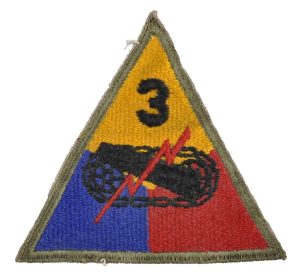
Shoulder sleeve insignia, 3rd Armored Division, (V1997.1.406).
Meanwhile, south of Zach was Hitler’s own bodyguard, the 1st SS-Panzer Division, ‘Leibstandarte Adolf Hitler’ leading the northern part of the German attack. The division spearhead under Joachim Peiper was slashing through the Ardennes toward Antwerp. Zach recalls being quite literally in the dark as they traversed the landscape not knowing the Germans had broken through the Allied lines, “It was foggy. This was called the Ardennes section of that part of the country, which was a low-lying, wooded area. We couldn’t see hardly over 200 yards ahead of us, very distinctly.”
Zach said, “The first thing we knew, we saw a line of tanks ahead of us parked alongside the road. It was so murky, we couldn’t tell if they was ours or the enemy’s. And we got up to them, right even with the first tank, a German tank, and their soldiers ran out and put their rifles to us.”
Soon the Nazis surrounded the platoon. Zach said, “The first lieutenant that was in command of us he said, don’t fire, don’t fire…They searched us.”
Captured
The German unit, as Zach recalled, was mostly tanks and personnel carriers and led by a German officer that could speak perfect English, presumably the ruthless Joachim Peiper (Peiper was convicted of giving the order for the massacre at the Dachau war crimes trial in 1945 – 47).
As Zach explained, “They wanted our vehicles… so, the drivers of these vehicles stayed…and drove.”
Zach’s platoon, now part of the German column, headed East and off the black top roads where the large German tanks chewed up the terrain. The vehicle Zach was in broke down, but the Germans wanted that vehicle and towed it. Zach and two other men got off and started walking but were not able to keep up with the tank column. They were then placed behind the turret of the tank commander.
Zach remembers, “Then we kept going quite a ways, cross-country…but after the three of us got on a tank, I never saw any more of my company. We came pretty close to another road and there were American six-by-six, two-and-a-half ton trucks, they were going pretty fast trying to escape from where they came from, which was just a little ahead of us.”
This group included members of Battery B of the 285th Field Artillery Observation Battalion who were on route to join the 7th Armored Division. This battery, of approximately 150 men, was not trained or equipped for frontline batteries; their mission was to spot enemy artillery. This lack of experience no doubt cost prisoners their lives as Zach explains later.
“These German tanks were firing on these trucks of ours that were trying to get away. They had captured, another German task force had, where several crossroads came together by a big, I call it a roadhouse, I think it was called Baugnez (a hamlet in the municipality of Malmedy, Belgium). They stopped and let us off and motioned to us to get in the other column."
After being searched again, their watches, rings, cigarettes and clothes taken by a different German unit, Zach said, “Then they motioned us to a little field over to our right, where they had captured many American soldiers and they were putting them in this little field, south of this roadhouse.”
“Well, they put us in the field, like I say, I judge there must have been a hundred of us. And this Second Lieutenant… his name was Lieutenant Iames (Lloyd A.). He understood German, and he heard them talking and he turned to me and says ‘Zach, they’re going to kill us.’ I didn’t understand much German. I just nodded to him…It didn’t look good.”
"Time to Hit the Ground"
Zach described the scene in the early afternoon of December 17th. Two German personnel carriers equipped with machine guns positioned themselves and turned their guns on the field of POWs lined up in four rows. “…they started firing at us. I was in the last row. When they started firing it took a little while to--anyway, when the bodies, the Americans in front of me started being blown backwards towards me, I thought it was time to hit the ground. But they kept firing long after they thought we were all dead…they left some Nazi soldiers there to guard us…there was nothing to guard anymore, but they stayed there.”
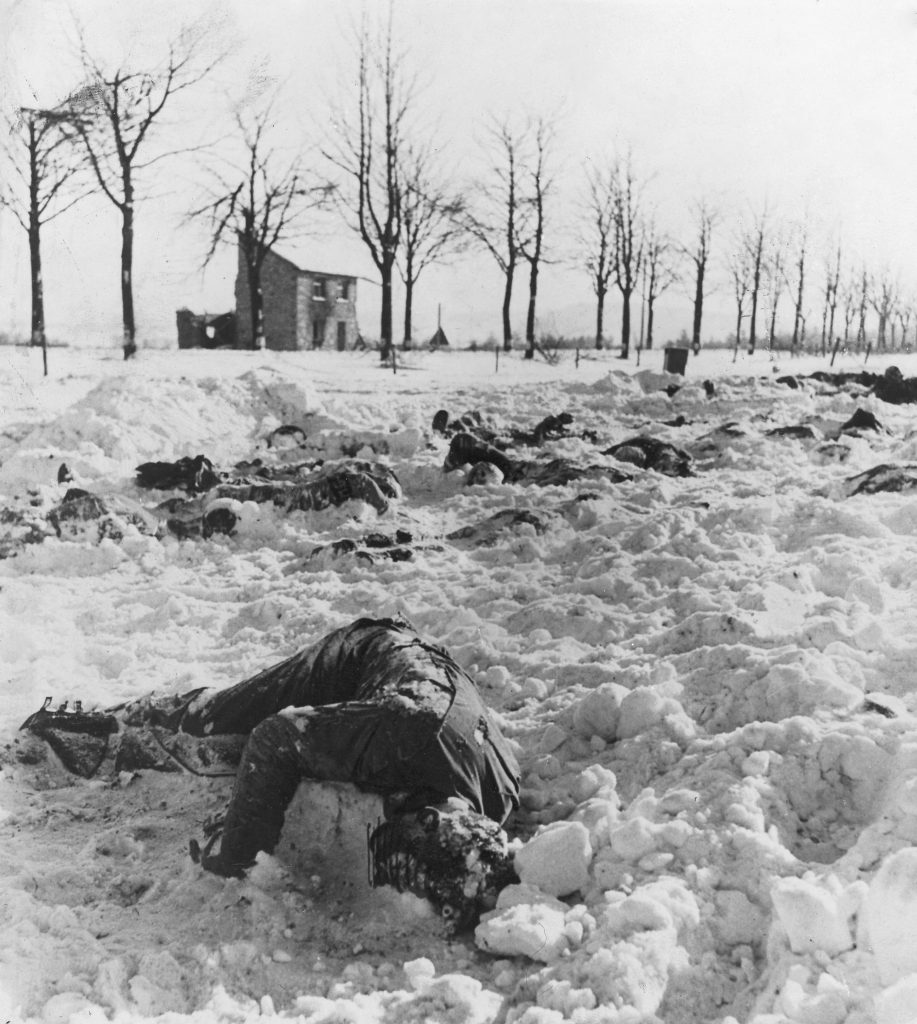
In the background, the burned-out shell of a building where Zach likely took shelter. In the foreground, "the field of the dead." Malmedy Massacre (National Archives NAID: 196544).
Some of the POWs tried to get up and run. A few made it to the roadhouse and a nearby barn but didn’t escape. The Nazis set the structures on fire and shot the POWs as they ran out. Hearing surviving POWs of the first round of shooting shouting back and forth, Zach could tell they had little combat experience. He begged those close to him to remain quiet and play dead until darkness fell. The men did not, which caused the Nazis on guard to enter the field and shoot any POWs they found alive with their pistols. Autopsies of the victims showed 40 POWs were shot point-blank in the head.
Zach explains their method, “They would try to kick us in the testicles and if you jumped, they knew you was (sic) alive. But fortunately, when I fell, I was lying face down. When they come kick me in the rump, I didn’t move. But they stood right next to me and shot my lieutenant…They just shot him in the head and when he fell backwards, he touched my feet.”
The systematic executions continued for another round before the German infantrymen left the area. Another column of German tanks met the departing unit at the crossroads. These tanks turned toward the field of dead bodies and fired.
As Zach recalls, “They raked us with machine gun fire…This is the third time that they tried to kill us. And I know as I laid there in that afternoon, I know four times they did this. They would be tanks or half-tracks or something come along and they would machine gun us, rake the field there.”
At this point in the late afternoon, Zach took a bullet to the hip. He laid in the field as the sun set. “And this is where during the afternoon I could smell the smoke and then when as it got dark, I could see the flames from it (the roadhouse). It was pretty well burned down by the time it was dark.”
Escape and Rescue
Zach decided this was his time to escape the “field of the dead.” He sat up and scooted backward toward the burned-out roadhouse, pushing himself with his arms and one leg as his other leg “was just hanging by a little muscle.”
Once at the structure Zach said, “… I tried to get as close as I could cause I was wet and cold. I had some beams that had fallen off of the house, the roadhouse and they hadn’t burned. But along side of them the roof must have had some of this corrugated steel. So I got by this beam and I put two of these corrugated sheets over me – leaned it up against the ground and the beam, and I got in underneath that. I wasn’t thinking of keeping warm so much as being hid.”
Zach remained under cover, bleeding, until the next afternoon when he heard voices. Taking the chance that they were Americans, and not caring if they were German, he called out. He was going to bleed to death if he didn’t get help soon. Zach was rescued by an American captain and two enlisted men in a command and reconnaissance car.
Zach remembered, “… they took me to what they say is Malmedy, and I was so bled dry that – they didn’t have whole blood, they had plasma at that time. They just added water to it. If I remember rightly, they put three units of that in me as fast as they could get it in there. By the time they got that last one in me, I was ready to go back up to the front and fight again. I was revived. But the doctor told me, ‘Son your war is over.’ ”
Memorials and Memories of the Malmedy Massacre
Reports say about 40 men escaped the massacre at the crossroads of Baugnez, although Zach never did see anyone from his unit again. The American Battle Monuments Commission has recorded three of Zach’s unit with a death date of 17 Dec 1944 buried at the Chapelle American Cemetery Henri-Chapelle, Belgium. They are Private John Klukavy of Michigan, Technician 3rd Class James G. McGee of Pennsylvania, and 2nd Lieutenant Lloyd A. Iames of California whom Zach named as his lieutenant.
For the remainder of his life, Roy Zach suffered with a bone infection from his wounds and bandaged his leg every day. The memories of the massacre at Malmedy never seem to have left him either. Sergeant Zach passed away on September 3, 2002.
Hearing Zach retell the details seared into his memory even 55 years after the massacre, epitomizes the life-altering implications of military service. Although it’s difficult to comprehend what Zach endured in that field at the crossroads of Baugnez, his retelling poignantly reminds us of the horrors we ask our young people in the service to endure. It is with great respect for all our veterans that we share this story. We remember the 84 POWs massacred at Malmedy in the hope this history reminds us of the ruthless nature of authoritarianism and the lives affected to halt its spread.
"The Malmedy Massacre: the Survivor Story of Henry "Roy" Zach was written by Jennifer Stevenson, Marketing Manager at the Wisconsin Veterans Museum. This post was adapted from an article first published in the Winter 2024 issue of The Bugle.