


The State Archive Preservation Facility or SAPF, pronounced by staff as “safe,” is a purpose-built, state-of-the-art space designed to care for Wisconsin’s historical artifacts and archives. The State of Wisconsin completed construction in 2017 and in 2018 the Wisconsin Veterans Museum moved its collections storage from the basement of the museum building on Capitol Square to the SAPF. The 188,000 square foot building is shared with the Wisconsin State Historical Society, the Wisconsin Center for Film and Theater Research, the State Capitol, and the Executive Residence for housing all sorts of historical collections not in use elsewhere.
Currently, a rough estimate for the Wisconsin Veterans Museum’s archival holdings, which includes anything that is paper, audio, or video, is measured at 3,000 cubic ft. of collections. This grouping contains over 2,000 processed collections and hundreds more that still require review and arrangement to make them more easily usable. Artifacts, three-dimensional items like flags, uniforms, and swords, number more than 26,500. The museum collection is broad and vast, and the SAPF building was designed to accommodate the special conditions needed to preserve a breadth of items.
The Wisconsin Veterans Museum portion of the SAPF contains climate-controlled storage spaces which adjusts both temperature and humidity conditions to slow deterioration of leather, wood, wool, cotton, paper, recording tape, etc. It also houses freezers to eliminate insect infestations in artifacts, cold storage for sensitive materials like film, a photography studio for documenting artifacts, a conservation lab to restore and clean artifacts, and dedicated spaces for object preparation and archival digitization projects. Through the series of profiles in The Bugle, you’ve met everyone who is headquartered there and cares for the museum collection: Andrea Hoffmann, collections manager; Sarah Kapellush, registrar; and Brittany Strobel, processing archivist.
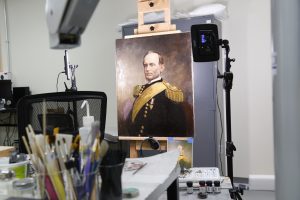
Currently in the conservation lab, contracted conservator, Craig Deller, is cleaning and restoring six chromolithographs from the 1870s that were rescued from the basement of a private home in Milwaukee. Here, Deller is cleaning an oxidized linseed oil layer to brighten the chromolithographs of Admiral David Farragut. In the background is a restored portrait of General William T. Sherman. The restored pieces will be installed in the G.A.R. hearing room at the Wisconsin State Capitol, which is the original location of the Grand Army of the Republic Memorial Hall, the precursor to the Wisconsin Veterans Museum.
As time marches on and the gallery space at 30 W. Mifflin St. remains the same size as it was in 1993, the space at the SAPF becomes increasingly important to the future of the Wisconsin Veterans Museum. Most museums of our size exhibit about 20% of their total collection. The Wisconsin Veterans Museum currently exhibits just 3%. Without the space at the SAPF to house its collections, the museum would run out of room to properly care for the items entrusted to it, let alone continue to have the ability to bring in the collections of recent service members.
A visit to the current Wisconsin Veterans Museum impresses visitors for certain. Behind these exhibits are hundreds of additional stories locked away in the SAPF. The SAPF enables the museum staff to continue to collect stories of our veterans and care for their historic archival pieces and artifacts. Being able to publicly tell the stories of a wider array of our veterans in a new purpose-built museum is the next logical step to honoring the service of all our veterans and encouraging an intelligent love of country for the next generation.

Behind the Scenes was written by Jen Stevenson, Marketing Manager at the Wisconsin Veterans Museum.
The article was first published in the Summer 2023 issue of The Bugle.