

Douglas M. Mauritz interview photo, May 17, 2024 (OH2905).
Marshfield, Wisconsin, resident Douglas M. Mauritz grew up between Washington state and central Wisconsin in the 1980s and 1990s. While his family lived in Parkland, Washington, outside Tacoma, his father taught him and his sister about country living on a farming property that they owned. Nevertheless, the change from city life on the West Coast to small town life in Wisconsin was an adjustment.
Mauritz entered the military after graduating high school, taking Air Force basic training in October 1995 at Joint Base San Antonio, Texas. His desire to serve his country reflected deep family tradition--uncles and his father had served in the armed forces during the Vietnam War era, his uncles in the Army, and his father in the Air Force. Mauritz's father had been a loadmaster on the C-130 Hercules during Vietnam and later stationed at Anchorage on tour, where he met Mauritz's mother. During World War II, Mauritz's grandfather served in the Aleutian War in Adak, Alaska, which gives Mauritz great pride.
After graduation from basic training, Mauritz attended Advanced Technical Training at Sheppard Air Force Base, Wichita Falls, Texas. He originally wanted to be a loadmaster like his father, but his recruiter and ASVAB scores directed him toward mechanics. Mauritz became an aircraft fuel systems specialist, loading and unloading fuel from airplanes and ensuring it reached the engines. As a fuel systems specialist at Sheppard Air Force Base, Mauritz worked with JP-8 jet fuel, a high-grade kerosene with low vapor content, meaning the threat of toxicity and explosions was considerably mitigated.
Mauritz on avoiding explosions while in-tank:
MAURITZ: Yeah. Well, the great thing about modern airplanes is that they've evolved away from the more toxic explosive fuels. They were using predominantly JP-4. And when I was in, all the aircraft that I worked on were a JP-8. So it was, it was, it was a high-grade kerosene. If if that's means anything to you. So it doesn't have. It does have a vapor content, but it's not really high like normal gasoline. The vapor kind of has a lot of vapors and a lot of off-gassing, but JP-8 and, like I said, I, I just worked with JP-8, so that was, that was the start of mitigating the problem, is just working with a chemical that wasn't as explosive as other fuels. Then the other thing is just realizing that sparks and fuel create flames. Because it's usually in an open-air environment. So, if you have the three things that, you know, fire needs to start, which is fuel, spark, ignition, and air. So, you limit the amount of sparks by grounding. Every aircraft sat on the ground, and it had a wire, like, look like a speaker wire, an old RCA jack. And it was just it was connected to the ground portion of the airplane.
Mauritz worked on KC-135 Stratotankers and E-8C JSTARS (Joint Surveillance Target Attack Radar System), both large aircraft frames that required hydraulic platforms to reach and access the wings.
Mauritz on working in a confined space:
MAURITZ: Because you were working, a lot of a lot of the, a lot of the planes, the bigger ones, you had to you had to be. Forgive me. Just a second. It's ayou would actually have to go in tank. So, it's an enclosed environment.
INTERVIEWER: Confined space.
MAURITZ: Confined space. Thank you. I couldn't think of the word. Confined space. Yeah. Confined space training. Part of your confined space training. Working in a fuel rich environment, you had to wear a respirator there. If you didn't, your ability to function, last, was about five minutes. The fumes of any residual fuel that were left in the tank, they would make you feel pretty stupid. I mean, you hear people huffing gas or huffing paint, you're crawling into a fuel tank that was previously filled with fuel. We would go in, we would mop it up using, you know, try and get as much out of there as we could and then pat everything dry with towels and rags. But it was it was still, I mean, this is this is all it was everything in there, the sealants, the parts and the components just smelled like fuel. And you couldn't, you couldn't completely get rid of it. I mean, there was, there were safe levels. We would do atmospheric monitoring and, okay, once it got down to X amount, you know, in so many minutes, then it was considered safe to work, you know, without a regulator.
The different structures in the wing fuel tanks made maintenance uncomfortable. The heavy aircraft contained rubber bladders for the fuselage tanks and sealed aluminum on the wings. In one particularly large job, Mauritz changed out a center bladder of a KC-135.
MAURITZ: One of the, one of the aircraft jobs that we had to do was, we actually had, you know, a 135 center bladder. We had to change out. So, the things were so big that you actually had to put a, a, a regular six-foot folding ladder in the tank with you and then use that to tie it to the top. And there were all these special, aircraft paracord lace. It was just, and you would have to lace it, lace it to the outside and then work your way from the top down, making all the connection fittings. But that was, that was a pretty big job. And I was, I felt pretty lucky I got to do that at one of my first, one of the first planes I got to work on. They're like, oh yeah, you, you're going to love this because this is part of your training. We don't get to do it that often. So got signed off on it right away. A lot of guys have spent a lot of time waiting for that job to come up.
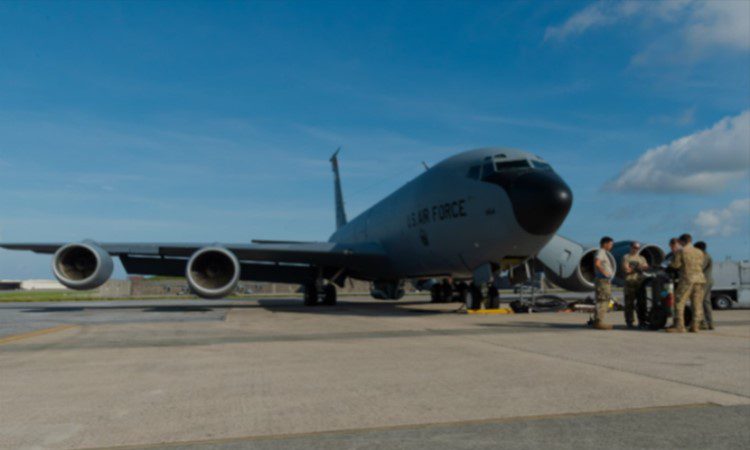
Photo by Senior Airman Cynthia Belio. Public Domain. The appearance of U.S. Department of Defense (DoD) visual information does not imply or constitute DoD endorsement.
The military assigned Mauritz to the 93rd Air Control Wing at Warner Robins Air Force Base, Georgia. Mauritz worked on the E-8C JSTARS, an aircraft designed to use radar to control ground-based traffic. Because of the airplane's top-secret avionics and technology, his shop had a high security clearance level. Mauritz also worked with the 55th Air Refueling Squadron simultaneously, servicing aircraft coming in for servicing from other commands.
The Air Force then assigned Mauritz to Eielson Air Force Base, Alaska, where he worked on fighters rather than tankers and heavies. En route to Eielson, the Air Force assigned Mauritz to a training squadron at Nellis Air Force Base, Las Vegas, where he took a F-16 Fighting Falcon fuels training course. Mauritz notes that the F-16's ability to fly upside-down was something new he learned to adapt to. Mauritz also emphasizes the systems of the F-16s auxiliary power unit (APU) powered by hydrazine, a rocket fuel. At Eielson Air Force Base, Mauritz served at the 354th Maintenance Squadron which serviced the 354th Fighter Squadron, which flew A-10 Thunderbolt IIs.

354th Maintenance Squadron performs phase inspection. Photo by Airman 1st Class Carson Jeney. Public Domain. The appearance of U.S. Department of Defense (DoD) visual information does not imply or constitute DoD endorsement.
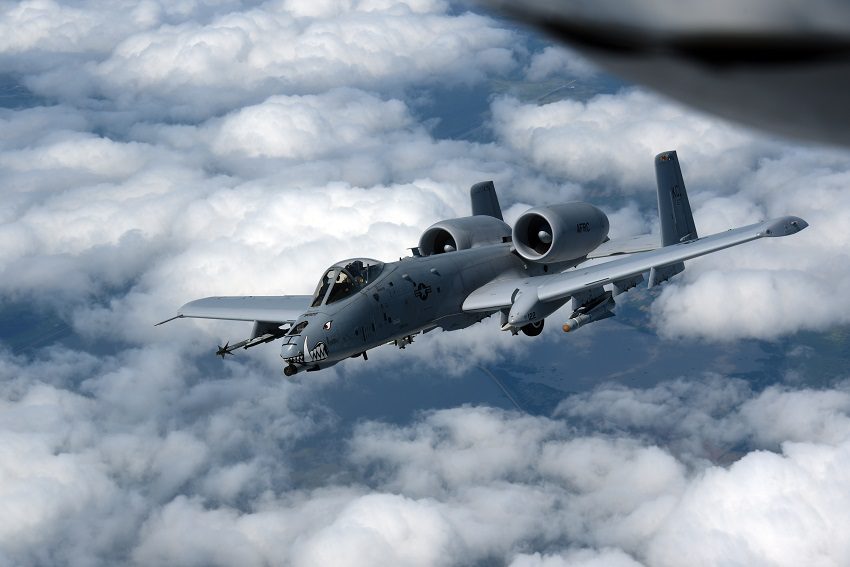
Photo by Senior Master Sgt. Vincent De Groot. Public Domain. The appearance of U.S. Department of Defense (DoD) visual information does not imply or constitute DoD endorsement.
Mauritz deployed as a part of Operation Northern Watch with the 354th Maintenance Squadron to Al-Jaber Air Base, Kuwait.
Mauritz on working on the A-10:
MAURITZ: I went over there with the A-10s and got, you know, got to do a couple things. When you're in country and, you know, things, again, you know, within all safe limitations, they, they move the needle as close to red as you can. So, some of the, you know, we definitely had, you know, if it was there was certain criteria. This is the bare minimum that we, that we will allow. You know, obviously if a pump wasn't working, you know, you had to replace it. But a lot of times, you know, the big thing were, was, that, you know, just they would start to leak, your, these things are hot. You know, they were just coming over from Alaska. When we came, when we got there, when we left Alaska, it was snowing. Cold. And then, you know, all the traveling across, the temperatures, you know, made the metal change and you developed a couple leaks here and there. But the reason why you were allowed to go is because you knew how to do those jobs quickly and efficiently. So that was the fun part.
Because of the engines' heat, the mechanics became responsible for mitigating fuel fires. In his interview, he notes that in his experience, the A-10s always returned unscathed by small arms or antiaircraft fire.
After rotating back to the United States, Mauritz got out of the Air Force in January 2000. He attended Mid-State Technical College and graduated from North Central Technical College in Wausau, Wisconsin. Mauritz first got involved with the Veterans of Foreign Wars at a district level as a judge advocate, quartermaster, junior vice commander (JVC), senior vice commander (SVC), and commander at Mueller-Hintz VFW Post 1866 in Marshfield, and as District 7 JVC and SVC. He became district commander in 2023.
Mauritz's twin passions:
MAURITZ: And in coming up through the through the VFW as a leader, I found out that, well, the VFW can authorize you to start a, motorcycle group, and you can get, you know, you can design your own back patch and, you know, ride around and promote the VFW and the auxiliary on motorcycles. Well, it's central Wisconsin. I mean, this is Harley Davidson was, you know, invented, you know, couple three hours down the road. And I love motorcycles. And all of a sudden, all of my veteran friends that, Hey, you want to you want to go, right? Yeah, I want to go ride. Hold on a minute. Why don't we do this? Why don't we get together as a group? So I actually established the Seventh District Riders Group for central Wisconsin.
Mauritz's love of motorcycles led him to help establish the Seventh District Riders Group for Central Wisconsin, which promotes the activities of the VFW and the Ride to Remember. The Ride to Remember is a motorcycle ride to the High Ground in Neillsville, Wisconsin, where riders from various veterans groups commemorate the sacrifice of the fallen. Mauritz sees the motorcycle community and the military community as interconnected, both fostering the values of freedom and fellowship.
For the full interview click on the image below:
