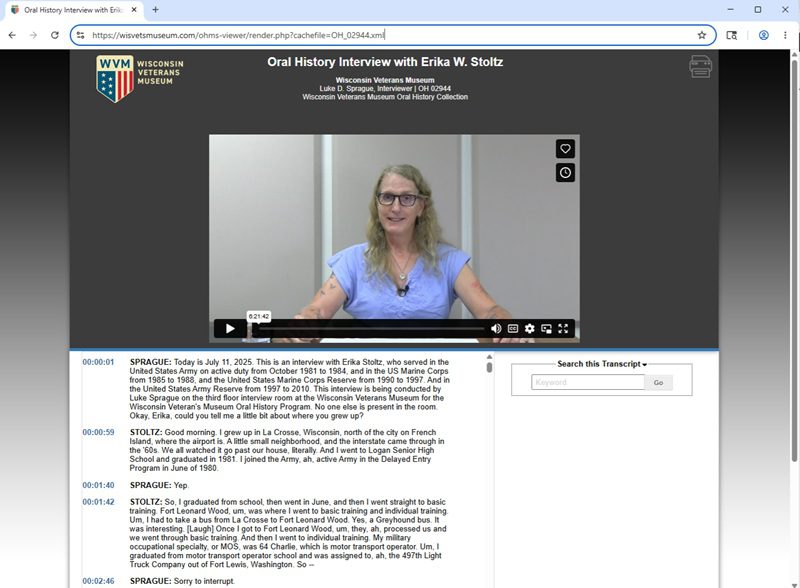
Erika W. Stoltz during her 2025 oral history interview with the Wisconsin Veterans Museum.
For many veterans throughout the decades, joining the military has been seen as a possible avenue for escape, whether from a difficult home life or a boring hometown. For Erika W. Stoltz, escape took on a new meaning: she had known since the age of four that she was a transgender woman. To escape into the military meant to hide from her feelings as long as she could.
STOLTZ: I joined the military because I needed an escape. [Laugh] I was fighting me. And ah, I knew at a very young age that I was in the wrong body. And ah, so, as a boy growing up -- with a woman's heart and mind, it was difficult growing up in the '60s and '70s and '80s. So, my father was very adamant about playing football, playing sports, wrestling, stuff like this.
Stoltz grew up in La Crosse, Wisconsin. Her uncles on her mother’s side of the family were all Navy veterans, which influenced Stoltz’s decision to join the Army in high school. In 1981, she boarded a bus to Basic Training at Fort Leonard Wood, Missouri. Later, after completing AIT, Stoltz joined the 497th Light Truck Company out of Fort Lewis, Washington.
Stoltz’s career in the military was unique. During her first three years of active-duty service with the Army, she was deployed to Germany, where she spent her time hauling fuel. In 1984, she decided she didn’t want to remain in her unit any longer, and the Army was not offering her any options to transfer. This led her to the decision to leave the Army.
She returned to Wisconsin, began studying law enforcement at Madison Area Technical College, and worked with the Iowa County Sheriff’s Office and a farm store. Feeling unhappy with work and school, Stoltz decided to re-enlist in the Army. Due to quotas, she was advised to enlist in the Marine Corps instead. From 1985 to 1988, Stolz served as an active-duty Marine. She trained as a mortarman and joined the 3rd Marine Division in Hawaii. She later deployed to Korea and, after some time, became a corporal in the Marine Corps.
Stoltz admits to struggling with alcohol while in the Army and Marines, and it became a coping mechanism for her identity struggles. At the time, she chose to push her feelings into a “little box” and ignore it as best as she could.
In 1988, Stoltz took advantage of an opportunity to receive an early discharge and go home. She returned to living with her parents in Dodgeville, Wisconsin. In November 1989, Stoltz suffered a terrible car accident that nearly killed her. The accident left her with her first major concussion, which contributed to later health issues. She spent months recuperating.
With two enlistments under her belt, Stoltz had barely any time to reflect on what to do next when Operation Desert Storm/Desert Shield began in 1990. Stoltz told herself, “I didn’t want to sit this one out.” She attempted to re-enlist in the Marine Corps but again, due to quotas, was told to enlist in the Marine Reserves in Milwaukee. Due to the war, she was later deployed to Saudi Arabia and Kuwait with Company F, 2nd Battalion, 24th Marine Regiment, 4th Marine Division.
In her interview, Stoltz recalls being present at major attacks by the US military:
STOLTZ: So, Kuwait, we were along the coast of Saudi Arabia and Kuwait along the coast. That's where the Marines were. One night we got word that I think it was the Iowa, the battleship, was going to be offshore shooting. So, the next day we woke up to the sound of Volkswagens being hurtled over us into the Iraqi positions. Yeah, into Baghdad or wherever they-- wherever they were shooting. But yeah, that sound of that Volkswagen being hurtled over, you know, that shell, a 16-inch shell. Yeah, it was interesting. But a lot of airplanes. So, the air war, they flew over. One night we took-- it wasn't close of the Scud attack. Scud missiles that hit within our area of operations. So, you know, we heard the-- it was at night, we heard the explosions. And we were-- we all went into MOPP 4, so nuclear, biological, chemical warfare. We put our masks on, the protective suit. And we all stayed in there for like, eight hours. Eight hours in that gas mask. Learned how to smoke a cigarette through the water tube. It was interesting.
After serving in the war, Stoltz returned to her Marine Reserve unit in Milwaukee, after which she was released from active duty. From 1991 to 1997, Stoltz worked a variety of jobs in the Madison area while traveling to Fort McCoy on weekends to drill. During this time, she completed training to become a combat engineer.
In 1997, Stoltz learned she was eligible to be promoted to the rank of staff sergeant. After missing her two opportunities to earn promotion, she was told that the Marines only had so many promotion slots to give, so she needed to leave the military at that time. Stoltz was discharged from the Marine Corps. But, eager to continue her military career, she then joined the Army Reserves in Madison and was promoted to staff sergeant.
At the time of the 9/11 attacks, Stoltz was working as a unit administrator for her Army Reserve unit. She also worked for the Department of Defense in a dual-status position, stating that to remain with the Army Reserve, she needed to work for the DoD in a civilian capacity. Around this time, she became a platoon sergeant, adding another responsibility to her list. In 2002, she was promoted to the rank of sergeant first class. For a couple of years, Stoltz would have her unit mobilization orders revoked due to her being deemed too important to administrative duties in the United States. Finally, in 2004, Stoltz received orders to deploy to Iraq as a truck driver.
Serving in Iraq at this time was difficult. Stoltz recalls driving through Baghdad and seeing the city littered with dead bodies, burned-out cars, and buildings on fire. As a truck driver, Stoltz was tasked with supervising a unit of armored cars equipped to withstand IED attacks and other dangers. Her unit was stationed at FOB Speicher, Iraq, which was a large, bustling area of operations.
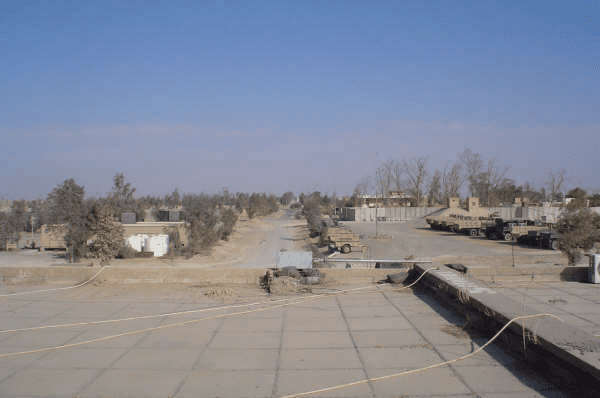
FOB Speicher in 2005. Author Zero Gravity at English Wikipedia, CC BY-SA 3.0, https://commons.wikimedia.org/w/index.php?curid=61982648.
Working as a platoon sergeant at FOB Speicher meant Stoltz was responsible for numerous security measures, including vehicle searches, providing security details, and conducting patrols. At this time, not only was Stoltz shouldering the immense responsibility of trying to keep her fellow soldiers safe and alive, but she was also still struggling with her gender identity. One major event in Stoltz’s time in Iraq was when members of a company at FOB Speicher suffered an IED attack:
STOLTZ: It was the Wild West. It was. How did the Army prepare for me? I think all my military career leading up to this, you know, between the Marine Corps, the Army and the Marine Corps, kind of-- kind of prepared my-- prepared myself. Plus, the pure fact that, you know, this is where I started really coming out as Erika. I started-- I started painting my toenails. I started to paint my toenails black and people would ask me, "Why are you painting your toenails?" I says, “to honor.” So, my first casualty was Iraq during this deployment. The company that was on the FOB, they were escorting one of their soldiers, was-- became a citizen. So, he had to go to Baghdad, to the Green Zone, and go through the ceremony of becoming a citizen. On their way back, their four Humvees that were coming in, that Humvee with the platoon sergeant, the driver, the gunner, and the person in the back, Specialist Jeffries, he, um-- they came in, pulled in a blocking position, and then the other three Humvees pulled in-- into the FOB. When he went off of that-- out of his position, he ran over an IED. So, what it was, it was an anti-tank mine with a 5-gallon jug of fuel on top of the anti-tank mine with a small anti-personnel mine as the trigger. So, when that Humvee ran over that anti-personnel mine, it ignited the fuel, which then ignited that anti-tank mine. So, the Humvee, they all burned to death. Not all. The gunner was ejected because he wasn't clipped into the harness. The driver escaped, but the TC, sergeant first class, I'll think of his name-- and they didn't make it. The sergeant first class, he made it out of country. He made it to Germany. He made to Texas, but he died in the burn center in Texas. But so, I was-- I was at the mayor's cell when that happened. And they wouldn't let me out. So, that was my first casualty.
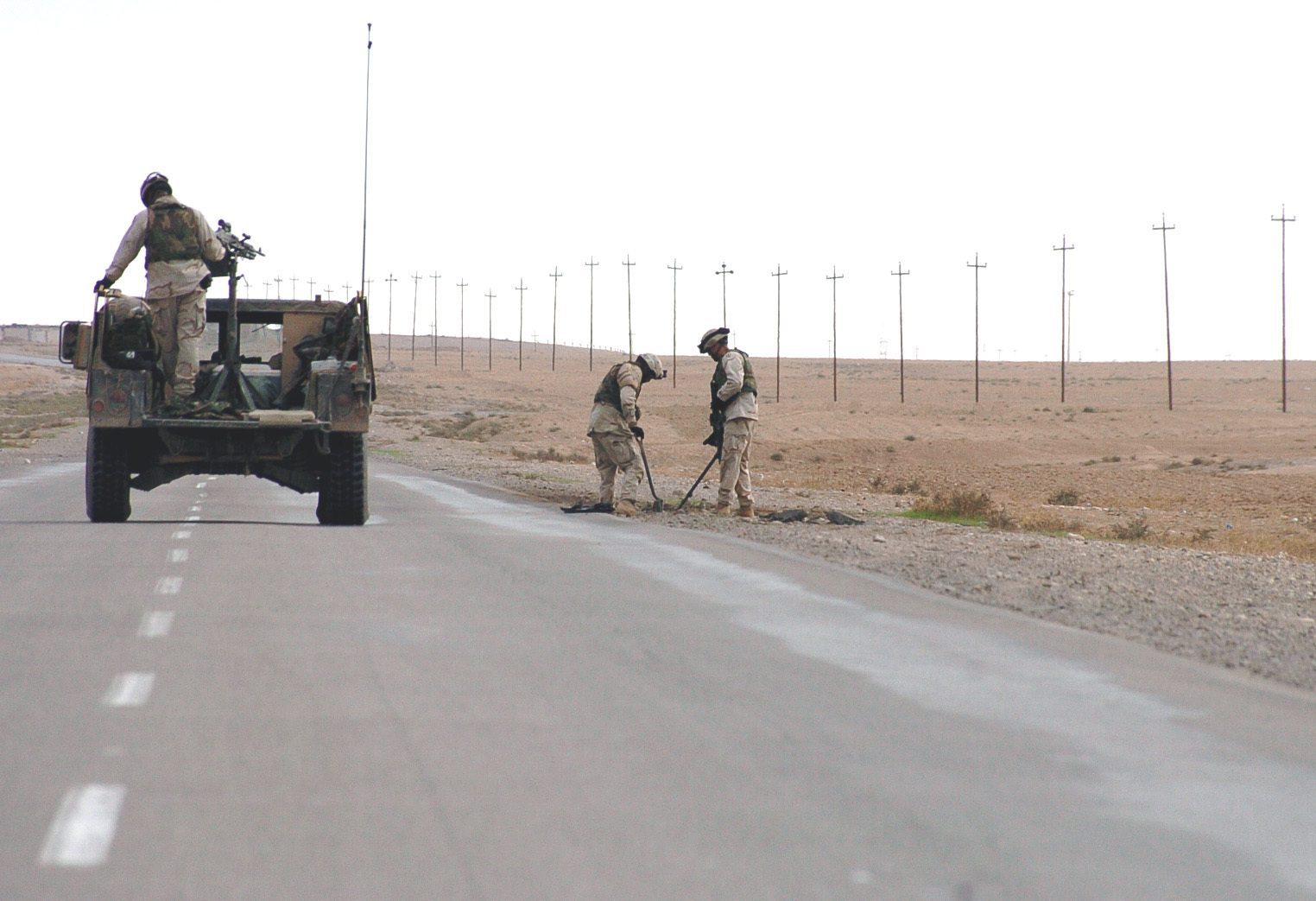
Sappers from Co. B, 65th Eng. Bn. check out an old IED hole while another provides security along a main supply route within TF 1-27 Inf. area of operations on Nov. 16. (Sgt. Sean Kimmons). Baghdad, Iraq. Nov 30, 2004. The appearance of U.S. Department of Defense (DoD) visual information does not imply or constitute DoD endorsement. 2126. Public domain.
In 2005, after one year at FOB Speicher, Stoltz returned home to Wisconsin. For two years, she continued drilling at Fort McCoy. She recalls experiencing some PTSD following her experiences in Iraq. During this time, Stoltz notes she lost a soldier in her battalion to an IED, as well as another to suicide. She continued dealing with difficulties in life, including a strained marriage and not being more present in her daughter’s life. She described her continued feelings of being a woman as “dealing with me.” These issues led to Stoltz’s making some stark decisions about her future:
STOLTZ: I had it in a box locked up pretty much. I mean, I was painting my toes. Trying to-- keeps my sanity that way. Um, you know, Iraq started to bring Erika out. Started to bring Erika out. But at the same time, it made Eric think that we need to end. So, I had some suicide thoughts at the-- at the same time. So, at the same time that I was cracking my egg per se, I was also contemplating ending it. At the same time. But my end would be death by combat. So, I started to go down that path, you know. But, for the most part, I kept everything to myself. I kept everything locked in that box. You know, I told my spouse, hey, I'm painting my toenails because I'm doing this to honor the ones I lost, you know. That was my excuse.
Life continued for Stoltz, and in 2010, her unit, the 469th Engineer Company, was informed that it would be mobilizing for route clearance in Afghanistan. Before leaving, Stoltz met with all her staff sergeants to discuss the realities of service in Afghanistan, including dealing with casualties and death.
Stoltz went to Kandahar Air Base FOB and was tasked with using radar and other equipment to detect and destroy IEDs on roads. Her unit did route clearance for the Canadian army. In her interview, Stoltz goes into detail on how a unit went out to look for IEDs and keep each other safe. Halfway through her deployment, Stoltz was sent to Camp Liberty, where she recalls British soldiers getting killed while doing their route clearances.
After several successful route clearances for Stoltz and her team, her luck would run out, and she experienced an IED attack:
STOLZ: July of 2011, vehicle number nine on Route Neptune, I see this line of rocks going across in front of me, and this road that's going down to the right and another line of rocks that's going across it. And something clicked in my brain, intel, that line of rocks says people don't-- don't drive past that because there's an IED. No sooner did I lean forward in my seat, everything went black. I got blown up. So, the IED went off right underneath me, on my truck. The RG-31, the front hub and half of the axle flew, wheel and all, 110 meters out to the field to my right. Roughly about a 300-pound explosive IED blew up underneath me. But the vehicle did what it's supposed to do, the V-hull. And so, we all got our bell rung pretty good. And, uh, major concussion number two. So, we lost power on the truck. So, I lost all communications with the truck, with anybody. The wrecker was directly in front of me. So, I’m the last vehicle, the wrecker was in front me. No sooner than I become aware of what we're going and asking everybody inside my truck, "Hey, is everybody okay?" And everybody replied to me that they're okay, that the wrecker operator jumped out of his truck and started coming towards me. And my gunner goes-- yells at him to stop. We don't know what's out there. Secondary explosions, secondary devices, we don't know. So, they did a clearance. The Husky came back and did a check around me. Then they did some handhelds around me to make sure there wasn't any devices. We didn't find anything. And then we just started doing recovery operations for my vehicle. So, they hooked it up like a tow truck, hooked it up. And we all went to different vehicles to make it back to the FOB. So, it was an interesting day. I don't remember the walk back from my vehicle to the vehicle that was in front of the Buffalo, one of my roller trucks, I don't remember that walk at all. Even today, how did I get up there? I become aware of where I was from inside this vehicle. And he's handing me a cup of coffee and a cigarette. You know, my staff sergeant. He goes, “Hey, Sergeant Stoltz, coffee? Cigarette?” I go, “Yeah, I'll have coffee. I'll have a cigarette.” So, I smoked a cigarette, I drank the coffee, and then we went back to base.
After a year in Afghanistan, Stoltz returned to Fort McCoy for demobilization. In 2012, she began visiting the VA to discuss ongoing headache issues. She also details seeing two different VA doctors, who both refused to diagnose her with PTSD. Eventually, Stoltz began seeing a psychologist at the VA about her gender identity, and this doctor ended up diagnosing Stoltz with combat PTSD.
Stoltz describes feeling more like “Erika.” She coped with these feelings in small ways, like playing as female characters in video games. Stoltz began to distance herself from her family and others. Around 2014, she received a call from an old friend, a former sergeant major, who asked whether she was interested in returning to Afghanistan. Stoltz, who was feeling suicidal, decided to go back, hoping she would die in combat. Around this time, the United States initiated a military drawdown, and this would be her last trip to Afghanistan.
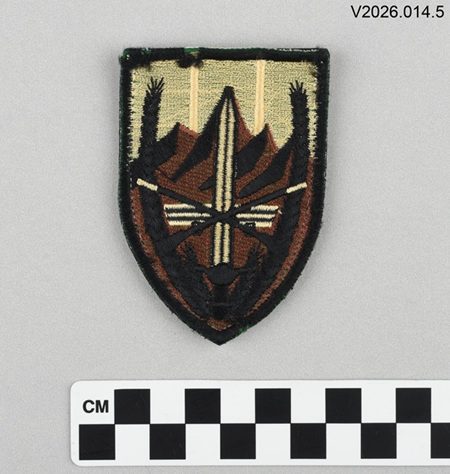
Shoulder sleeve insignia, U.S. Army Element, United States Forces - Afghanistan. Stoltz wore this patch given while serving at Shindad Air Base in 2015. WVM V2026.014.5.
When Stoltz and her unit arrived at Shindad Air Base in Afghanistan, they had no mission for half a year. Stoltz spent the time playing video games and watching movies. Stoltz also notes that she began shaving her legs, painting her toenails pink, and researching transgender soldiers in the Army. When she finally received more route clearance missions, she experienced other close calls with IEDs and small arms attacks.
When she returned home to Wisconsin in 2015, she finally told her spouse that she was a woman. This began her transition in earnest:
STOLTZ: So, I started seeing a therapist at the VA, a psychologist, about early 2016. And then the Secretary of the Army came up with this-- the policy, the transgender policy for the Army. So, when that came about and I started having talks, uh, email communications between me and a couple of other military transgender people about what's the policy and how-- what do we need to do to change our gender marker in DEERS [Defense Enrollment Eligibility Reporting System]. Came out to my company commander. Came out to my platoon sergeant-- I mean my boss, my civilian boss. They immediately changed my gender marker in DEERS from male to female, on the civilian side, not knowing that it also did it system wide. So, my gender marker has already changed, you know? So, were they supposed to do that? I don't know, but they did it. So, you know, I started going through counseling, started presenting, uh, female at work and continued my therapy with the psychologist at the VA. I started, uh, hormone replacement therapy.
By the end of September 2016, Stolz was moving forward with her transition. She was seeing doctors and working on her Army documentation. At the same time, she was dealing with the rapid changes and how they were impacting her wife in particular. Stoltz stressed that her transition was necessary for her mental health. This difficult process was made easier by the support of the people around her.
STOLTZ: And as soon as I got down there, I knew their company commander. I knew him when he was a second lieutenant. Kurt Pierson. And he pulled me into his office. He was the captain at the time, and he pulled also into his office and he says, "Okay, what do we do?" I was like, "What do you mean, sir, what do we do?" And he goes, "I have no idea howwe're gonna do this. How we're going to proceed." And I said, "Sir, neither do I." You know, but then he asked me the question. And it came out in the book. "Can you perform your job?" It's in this book. And my answer was, my military commanders, most other people that I was involved in with the military, it didn't matter. It didn't matter that I-- that I am transitioning. It didn't matter. All that mattered was that I was a senior noncommissioned officer and I could do my job. And they said, "Okay, as long as you can still do your job." It doesn't matter. It doesn't matter. And they supported me one hundred percent.
Stoltz went through with her paperwork to transition in the Army and moved to the 646th Area Support Group in Madison, Wisconsin. She noticed that men and women in the military were frequently separated, and that communication was severed because the military was deemed a “male society.” Stoltz worked to fix this by having the women’s barracks be next to the men’s barracks to encourage interaction. She also spoke with women soldiers about her transition and let them ask her questions. She noticed that once she was more open about her identity, other LGBTQ+ soldiers would open up about themselves.
In December 2019, after thirty-four years of service, Stoltz officially retired from the military as an Army master sergeant, having served four combat tours. She received numerous awards and two Bronze Stars. At the time of the interview, Stoltz was working for the United States Department of Agriculture.
Being a transgender soldier, Stoltz chose to assert her community’s existence in Wisconsin and the United States. Stoltz was motivated to participate in the Wisconsin Veterans Museum Oral History Program because she feels every veteran has a story to tell, and that these stories are worth sharing with the public.
STOLTZ: I think that people are gonna be people. You can't put them in boxes. You can't. It doesn't work. So, if you think about this, they have found evidence of transgender people dating back to Egypt time. The Native Americans have two-spirited people. The two-spirited person is a transgender person. We've had transgender soldiers serving in battlefields from the Civil War to today. We're always gonna be here. We're not going away, you know? It's just that in the '70s, it was gay. Now, it's us. We're the ones that they have to pick on.