

Seventy-five years ago, the North Korean military invaded South Korea. Here is the story from veteran Valdor W. John, Sr., who fought at the Battle of Taejon and witnessed first-hand the Allied effort to delay the North Korean advance. John became a prisoner of war and then survived the Tiger Death March and Sunchon Tunnel Massacre.
In this 2004 oral history interview with Wisconsin Public Television, Valdor W. John, Sr., a member of the Oneida Nation from Oneida, Wisconsin, recalls his experiences in and following the Battle of Taejon (July 13-20, 1950), in the early weeks of the Korean War.
John enlisted in the United States Army in 1948, and because he was underage at the time, he had to get his parents’ permission to enlist. He completed basic training at Fort Knox, Kentucky, and in June of 1950, he served as part of the post-World War II occupation force in Japan. He was enjoying occupation duty and was returning to his post in a jeep when he was told to get in line for immunizations and to pack up his belongings. The rumor his barber told him turned out to be true: he was going to Korea.
At the opening of the Korean War, John said his chain of command told the soldiers that the North Korean fighting forces were “armed with nothing but pitchforks and clubs” and would offer little opposition. His unit deployed as part of the 24th Infantry Division. Soon after he arrived in Korea, he encountered enemy forces that proved to be more formidable than he, or perhaps anybody, had expected.
John: So, we went marching up into the hills and we were digging in and I think it was the next day or something I think that we ran across, we come into some contact with North Koreans. There was quite a few of ’em. They saw us and, and they pulled out and moved out and went back and I thought they were gonna go back and back across the 38th Parallel. We dug in anyway, and the next thing we know we were we were surrounded by ’em--thousands and thousands of ’em. And they came down and they started attacking us. We didn't have nothing much to hold ’em back with then as far as big guns or anything like that. So, we just had to retreat. And that was our life for the next three or four weeks—just dig in, retreat and run and try to survive.
In July 1950, the command sent his unit north and west to Taejon. John says that there was little support available, and the North Koreans nearly surrounded them after a few days. He was among those tasked with defending against North Korean tanks with a bazooka.
John: So, we were sent out, I think, there was three of us, three teams, were sent out, we were gonna protect this road from the airport into Taejon. And, these tanks come down, and the road was high enough off the rice paddies, where only a tank could go one way, they couldn't turn around on it. So, when we got out there, we'd fired at the first and last tank and the center tanks and then started destroying the other ones. And they couldn't turn around. One tried. They'd fall over into the rice paddy, and so--. I remember we got, I think it was five or six prisoners, come out of there. They were burnt up pretty bad, so we, we escorted ’em back in there, two or three of us, and we brought ’em back into Taejon and turned ’em over to the South Koreans. And we stopped the tank--that tank from coming into Taejon. Blocked that whole road off, and I don't know how many we destroyed, quite a few of ’em, but they couldn't do any damage, couldn't go either way after we fired on ’em. So that stopped them for a few days.
Outnumbered and underequipped, the last elements of the 24th Infantry Division retreated from Taejon on July 20, 1950. John recalls that the city was “flattened,” and that Major General William F. Dean, the commanding officer, ordered a retreat.
John: No matter which way we went, we were surrounded. And they were just machine-gunning everybody. Try to get on a truck or try to get on a vehicle, you got shot out from under it and I don't know how many vehicles that I got on ’em and knocked off and--driver shot, or we fell off the road or something. I got run over by one of our own Jeeps, over my leg and broke my leg. Not completely, but one of the bones in my leg. And I got hit in the hip by small arms fire. And I kept doing that and I didn't get very far up that road, trying, the road out of Taejon, and, the last one was on a big truck, two-and-a-half-ton truck, they had about sixty of ’em on there and they reached out and grabbed my hands as I went by and I pulled up on it and the same thing happened there. It was shooting. And they got the driver again, I guess, and we smashed into a building, and they were just slaughtered. All those guys on that truck were just slaughtered. I managed to fall into a rice paddy, and I saw ’em then. They were just picking ’em off, picking our troops off, just left and right, so I just stayed in that rice paddy along the edge there. There was big mounds there along the side of the rice paddy, and then you'd have the water in there and stuff and I'd lay there right in the corner and, and just lay there, and they were taking pot-shots at me all afternoon. They come in close, and I guess whoever was doing that finally got tired or convinced that I was dead, so he stopped shootin’.
After several hours, the North Koreans were gone, and John started uphill toward the mountains, where he came across another wounded soldier and later General Dean and his staff. John and the other wounded soldier could not keep up with General Dean and his staff, so they went alone. After a few days, the North Koreans captured them and took them back to a jail in Taejon.
John: By the time we ended up there was, I think there was about six or eight of us in or ten of us, something like that, in that little jail cell. And those little characters would come in there and threaten us every day. Ten times a day would be threatening us to kill us, and he spoke pretty good English. And he'd come in there and he'd preach to us in communism about communism and all this, and then, then he'd turn around and end up gonna kill us and threaten us and pull the bolt back on his weapon and stick it to our heads and, aw it was just--. I was ready to give up and say shoot me, you know, and stop this crap.
John and his fellow prisoners, nearly 800 in all, were forced by the North Koreans to march north. This march became known as the Tiger Death March. Here John describes it:
John: So, then they, then they started marching us day and night. We marched, all the way through Pyongyang--Pyongyang the North Korean capital. And there wasn't very many, very many left. There was a lot of sick. They’d get this dysentery, and if they couldn't keep up, they just, they'd shoot ’em alongside, you know, along the road. And stick a bayonet in ’em and make sure they were dead, and they wouldn't let us bury ’em anymore. And just, I don't know how many people we'd lose a day. They just couldn't keep up, and they'd just give up and rather die than keep on going. So, when we ended up in Pyongyang there was, oh, I don't know, about half that many left, about half of us that started.
The North Koreans loaded John and his fellow prisoners onto a train. They traveled a short distance into a tunnel. John was among twenty-five prisoners taken off the train and into a nearby wooded area.
John: I looked around and here all of a sudden, guards come up with machine guns and on all sides of us there and just started shootin,’ firing machine guns at us, and we couldn't, couldn't get out of there. We were in this little hole and just started shooting and hit. I got hit, and I hit the ground. And they kept shooting. And I still believe what happened, what saved my life today was this guy next to me got shot in the leg, and his leg was right next to mine, and it blew all that, all that flesh and blood all over my face. And so, when they come to look at me, they pounded on my back and broke a few of my ribs, and they stuck a bayonet in me, just on the right side a little bit. And I didn't move, and so they just walked away and thought I was dead.
Several days later, the United States military rescued John and sent him to Japan to recover enough before being sent to Brooke Army Medical Center in San Antonio, Texas. This event became known as the Sunchon Tunnel Massacre.
John: I was in a cast 'cause my, both my legs were broken and my left arm and my ribs, so I was in a cast, except my right arm and, and the bus dropped us off at the, it looked like an old train station or something there in San Antonio. We were supposed to be picked up and then taken into the hospital for triage or whatever. And I was out there, laying out there in this hot sun on this deck, and finally somebody come by and asked me if I'd been in an automobile accident or something. And I told them, "No," I said, "We're waiting here to be put into a ward, we're coming back from Korea." And they didn't know where Korea was [laugh]. You know, it was just, the war had just started they hadn't heard. It was kind of a quiet deal, I think. Oh, we got up on the ward and, and then they, my records was underneath me so they found them, they took ‘em out and, and one of the nurses said, "Oh my God,” she said, "These guys were coming back from the war," he said, "He's a liberated prisoner of war," so they really started shaking and giving us some attention, you know.
When John got home, he got a warm welcome.
John: I went home and came back to Milwaukee and there was a huge reception out there at the airport. The VFW [Veterans of Foreign Wars] and other organizations were out there. And, and my old school, all the friends and relatives. It was quite a--it was quite a deal. TV was interviewing us and, and, this friend of my father's, he was a department store owner there in Milwaukee, he, he organized a little homecoming dance, band and so forth, and, at the, at the VFW hall there. So, that was real nice, got there and that's when I got the, they presented me with the headdress for chief warrior, I mean, yeah, chief warrior it was. So I'm an honorary chief warrior of the Consolidated Tribes of North American Indians. I had the other places I had to go and speak at different functions they had there in Milwaukee. It was nice.
Years later, John trained soldiers on the M42 self-propelled anti-aircraft gun in preparation for service in Vietnam. He felt protective of these soldiers and convinced the Army to let him deploy with them.
John: But you get that feeling then I had, I think I had close to eighteen years, something like that, not long from retirement, but, you know, you get that old soldier feeling and you, you know you got these little chicks under you, you know you gotta watch and protect, and you don't want nothing to happen to them that happened to you and that kind of feeling. And, uh, that's the way I felt. So, I talked it over with my, my wife and family at that time. They, they just agreed with me. They, they felt that's what I wanted to do, that's what I had to do. I went over. I went over twice, two-and-a-half tours I ended up going to Vietnam. And the only battle I got into over there that was really, really a big one was the Tet Offensive in '68, '69. That was, that was a tough fight there for--overnight battle. But other than that it wasn't, it wasn't nothing like Korea [laugh] you know. It was a little more of a mine, we had to watch out for mines and booby traps and that, that thing, that nature. But as far as a line and, you know, being attacked openly and all this, it, they didn't do that in Vietnam. It was whenever they felt like coming out, they'd come out, fight, and go back in their little holes and you'd never see ’em, or catch ’em even.
For the full interview, click on the image below:
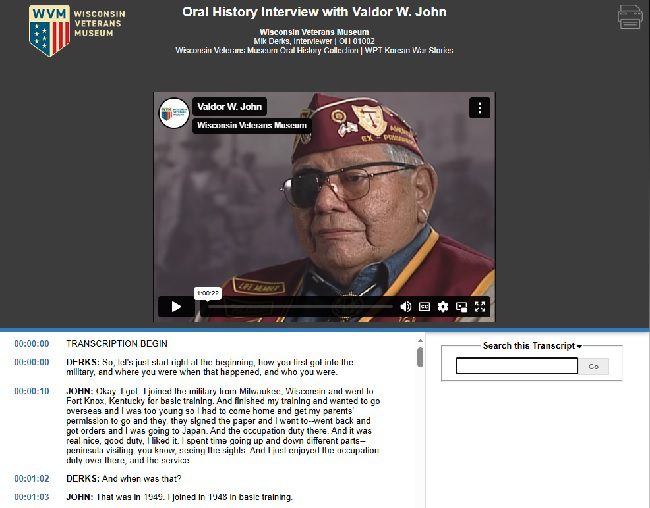
John retired after twenty-six years of service in the Army. He passed away in 2008 and was buried in Oneida. For a more complete profile on the above veteran, please click on his name Valdor W. John, Sr.