
The holiday season offers a unique opportunity to touch on a poignant topic for veterans, the holidays, and usually, we would provide you with a full context for each veteran who served.
However, in this case, we would like to focus on short, stand-alone stories that provide a better sense of the veterans’ experience during the holidays.
In this montage, veterans recall their military experiences during the holidays.
Donald Beseler recalls the Battle of Bulge during World War II:
BESELER: There was a rather interesting thing. When the Battle of the Bulge started on the 16th we lost our kitchens that very first day so we had no hot food, rations were very slim, but I had a very resourceful jeep driver. We had one jeep that was left, and he went back to get some supplies, whatever he could find, ammunition or food or something, and he came, showed up, and he had a sack of rice. So on Christmas day we had a sack of rice that we cooked in our helmets, and somewhere he had relieved, I imagine, a general officer someplace, of a bottle of gin. So the few of us sat around, and we ate our rice, and we had a bottle of gin, and as his commanding officer I didn't ask him where he got it. We [laughs] were just thankful that he found it. Also, Christmas day, in that position at Manhay there, just before we withdrew, the chaplain showed up with his jeep, and we had a very short Christmas day service on the hood of his jeep, and probably the most impressive church service I've ever been to in my life because the Germans were just a few hundred yards away.
While serving in Afghanistan, Andree Griffin chronicles Santa Claus:
INTERVIEWER: What was it like being away from family and friends?
GRIFFIN: Um, it it was definitely hard, especially getting there, you know, right before Thanksgiving, being there for Christmas. And, um, you know, we tried to make the best of it. Um, one night that we had free one of the sergeants dressed up as Santa Claus, and we took pictures with our M-16 sitting on Santa's lap [laughs].
INTERVIEWER: Wow. Okay. Huh? So what in particular? What was. Yeah, What else. What else was. Tell me. Tell me a little bit more about being out at Christmas time, and being deployed, if you would?
GRIFFIN: You know, I mean, I. I mean, you think of everything that's going on back home and, like, Christmas is one of those times where you see family that you don't see a lot. So, you know, and being there and it's, you know, was it about an eight-hour time difference? So you don't necessarily have downtime, you know, the time that everybody else is getting together and being, it it sucked, like, you know, it's not, what, obviously, you know, nobody would choose that. But, like I said, we distracted each other from it. We tried to, like I said, make the best of it. Like, you know, we're our family for this year. And.
Larry Reed near Tan Son Nhut Airport Vietnam in December 1965 with Santa:
REED: But I remember one occasion that we we it was Christmas time and we raised some money and we bought a lot of things from the PX to bring to the orphanage near Tan Son Nhut airport, a Catholic orphanage. And the Vietnamese ladies and some of us officers gathered the material and went there and the big bags of gifts for the orphans. Unfortunately, it seemed like the entire city of Saigon, all the orphans and young kids in Saigon realized what was going on. So they also came to the orphanage near on Tan Son Nhut. We were swamped with young children wanting gifts, wanting something from the Americans, wanting the candy, wanting the little gifts we were giving out at the legitimate orphanage at Christmas time. And we were swamped. But we made a big mistake with the Air Force, with the Army, I guess, Air Force. And that was to have Santa Claus arrive to cheer up the kids. And the Santa was going to arrive by helicopter and land near the orphanage near Tan Son Nhut, a big open space, well, the hundreds and hundreds of children that were handing out gifts from the chapel windows because we couldn't be outside. There were too many kids. We had opened the chapel windows and give the gifts out through the windows. We were swamped. Well, the kids saw this helicopter, the Army helicopter, landing near them. They panicked in fear. They thought that we were being assaulted by some helicopter and the children ran screaming away from the helicopter. So, of poor Santa Claus, we got off the helicopter and his red suit and big bag of gifts, the kids had scattered out of fear. They thought there was an assault going on, and they might be killed or injured. It was like a battle action scene, but, nobody got hurt. And the kids did come back when they realized just that jolly old St. Nick was there to hand out more gifts. But it was terrifying. You realize how much suffering went on, the children, the orphans and the people in that war. And that's the only time I confronted that idea that we were not succeeding, as it were, with the people. It was a guerilla war of the people, and we didn't have a handle on how to deal with the people in general. I can't be more specific than that.
Leda Zoroghlian Patrick encouraged singing while serving in a hospital in Puerto Rico:
ZOROGHLIAN PATRICK: So, every Christmas, we would get all the Latin music and we do the paranas, and the paranas is walking all around the hospital, singing guayas, which is the Christmas songs, and a lot of non-Latinos would join us, just to do the caravan, and they got more involved in the Latin culture, specifically in Christmas when we did the paranas in the hospital.
In the Pacific Theater during World War II, Lawrence Pankratz remembers decorated palm trees and chaplains in shorts:
PANKRATZ: Yeah we was there for, oh it must of been, well, we was there Christmas because Christmas I went to, there was a bunch of us went to a midnight mass and that was about a, oh maybe a three mile walk. We got there at midnight and the chaplain, he was in shorts at mass, shorts. They had the place all decorated up at night with, oh these aircraft lights- you know. They had them shining on the palm trees up there. They had crepe paper over them, all different color of crepe paper. That was just, well every color you could think of. It looked like something out of this world you might say.
Robert Botts fighting the Japanese in World War II on the necessity of milk for American troops:
BOTTS: And one time for Christmas, they was over there. And, one of the chaplains got up. He said, "If you guys could have anything that you wanted for breakfast on Christmas Day, what would you like to have?" Want to make a guess?
INTERVIEWER: Eggs?
BOTTS: Uh-uh. Fresh milk! Those guys got three DC-3's somehow, and we had ice cold milk Christmas Day. And, when we got back to the States, they didn't run to the beer bar. There was a dairy bar up the street. Them guys go in and grab two quarts of milk, an' set on the curb 'n drink it.
Vietnam veteran John Koeppen on religious services inside the wire:
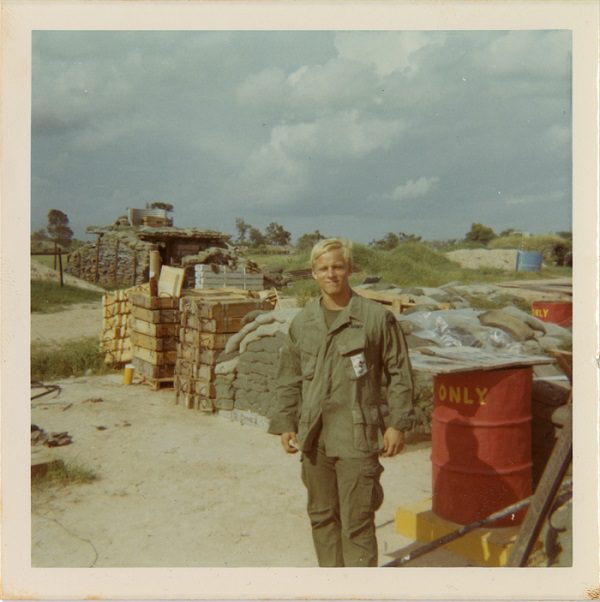
Photo credit: WVM.1543.I084e
KOEPPEN: So it was around Christmas time and so, we had been doing patrolling for a couple of days and it became Christmas day, so in the Army, in the service of the Army you always brought you a hot meal. So they were going to bring a hot meal out to us, it was turkey, it was Christmas and that was one of the nice things about it. So we kind of got into an area and we set up our little position and we were going to have Christmas come in so then, the captain asked, or the lieutenant asked if anybody here is not Lutheran. And so a couple of us raised a hand, I was Catholic and all that. So, then he said, we are going to have a chaplain come in. We said okay. So we went out, we are in a tree line in the jungle line and there were some open space where, some small bushes and some grass and so we get set up a nice perimeter. So a couple of us will all grab their little weapons and grab their gear and we went out to different points and the chopper came in. And the thing that shocked us was we thought he would come in, drop them off. He didn't, the engine, the chopper just cuts its engines went into a rest. So the chaplain was going to do service, so he goes over and does service and the next thing that I know, the next thing that we hear is that he had brought a tape recorder and so he was playing church music, probably as loud as it could be and we are listening to all of this Christmas songs and we are all sitting there, the guys who were out on the perimeter were like, "Holy shit!" You know you can hear this for a long way and we couldn't believe it and then he did a whole hour service. Gave us communion and all that. Got back in his chopper-- and plus the fact that the chopper came down and sat down there for a whole length of time, we were afraid that any enemy in the area could have seen that, did the chopper go back up? Want to run home and get his little mortar tube or something like that? See if he could throw a mortar or two. But fortunately, nothing. He took off and then we had our hot meal and it was just one of those moments when we were like, Good god is no one thinking about what they are doing here anymore?
Linda McClenahan rewrote Jingle Bells to reflect her Vietnam experience:
MCCLENAHAN: We rewrote Christmas songs, too. You ready?
INTERVIEWER: Please do.
MCCLENAHAN: Okay. "Bouncing o'er the roads in a Jeep that should be junk, laughing all the way, most of us are drunk. They bomb holes on the road, they make our asses sore, god, I'd sooner go to hell than finish out this war. Oh jingle bells, Santa smells, Charlie's in the grass. Take your merry Christmas wish and shove it up your-- Christmas time is here, the folks back home are gay, we're stuck over here--" I can't remember the rest of it but you get the idea.
Darryl Johnson reflects on the visitors who brought sandwiches to his Vietnam outpost:
INTERVIEWER: You wrote something about Christmas and a visit from the Donut Dollies.
JOHNSON: Yeah. We were on a hilltop, it was pretty secure. The patrols that we had sent from that hilltop were patrols that I was on all the time. It seemed like we were there for several weeks, and those patrols occasionally encountered the enemy, but the hilltop itself was pretty safe, and it was lots of wire and bunkers and things and so. It got to be Christmastime and we said--and we were very close to the border--and we said, "Is there any way that we can get some hot chow, just a hot meal on Christmas would be nice. Forget about turkey and gravy, just a hot meal, and do you think so?" Traditionally, Christmastime was a fairly safe period, the North Vietnamese would back off, and that was true. So, the report came in, "We've got some chow for you." "All right!" We're all wondering what this is going to be, and the birds come in and land, and the food in the heating units coming off, unloading, unloading, and here's these girls on the plane, in kind of blue-gray dresses, "We're Donut Dollies," we're called. Today, I think that would probably be a little disrespectful, but "We're Red Cross volunteers." And uh, well, forget the food, we want to talk to the girls, and it turns out the food is bologna sandwiches. We had bologna sandwiches on Christmas, but they brought Monopoly, a game where you guess the capital of the states, and everybody knew their own capital, but they struggled with everybody else's. They sat with us on the bunkers and had us laughing and playing games, and it was sad to see them go when it was getting dark out, "You've got to go?" They sang songs. One had a guitar and could play songs and it was really nice. Asked them what they did back in--because they were in base camp most of the time--most of them said they never had been out in the field so far. We let them look through our binoculars and things like that, at the countryside, and pointed out things and stuff, and it was just really, really nice. Everything was well supervised, so nobody got out of hand with the girls, cause we, I think probably thought that "Well, maybe they'll come and see us again." [laughs] So, that was just a nice little Christmas. You could actually pick up, on our transistor radio, somehow they were re-broadcasting football games from the States, and I think the NFL might have played--if it wasn't on Christmas Day, the NFL might have had a game the day after or something--and so we listened to a football game. It was a nice little interruption, and then it was back to reality right after that. The Donut Dollies, I just felt that they were brave to come out there, even though we knew it was safe. Still, to leave home and go all the way to--I mean these women--most of them had college degrees--could be working in the States. What are they doing volunteering for the Red Cross?
Donald Heiliger explains how putting on a show changed their treatment as prisoners of war by the North Vietnamese:
HEILIGER: And shortly after we moved in there, it was Christmas. And somewhere along the line, the Vietnamese discovered the contraband that was coming in in our packages. And we were getting packages. I got my first one two and a half years after I was up there. Two-pound box of Fanny Farmer, from my folks. They knew exactly what I would like. Other people were getting pipes, sweaters, tobacco. All kinds of stuff from the States. And the Vietnamese were happy to give us a package. Why I only got that one and no other, I am not sure. I didn't get another one until probably four years after I was there. I got my first letter almost four years after I was shot down. Mail was very slow. But we were getting packages. And they had some American stuff, like I say, sweaters and things. And just before Christmas of 1970, when they discovered this contraband in the packages, a piece of candy, if it contained a whole microfilm of the New York Times. Things like you would break apart and find these things. So, the Vietnamese discovered this stuff. Came up and ripped everything American away from us. Everything. Left us with just basics. Whatever the Vietnamese gave us. Kind of a sad situation just before Christmas. But I know in our room, and I am sure in the other rooms. I can't say for everyone. We just said no, this is not going to ruin our Christmas. And we are going to do things. We weren't not allowed to have a Christmas, we weren't allowed to have a church service. That was against the camp rules. We weren't allowed to sing. We weren't allowed to have a choir. Nothing. We said, "Screw it, we are going to do it.". So, we put on two programs that year. One we did the play, A Christmas Carol, we made our version of A Christmas Carol. And I was Mrs. Cratchit. And nobody ever gave me any awards for it, but I thought I was fairly good as Mrs. Cratchit. The other thing we did was we decided we would put on a religious portion, and it was kind of like going back to Sunday school programs in a way. I had a good memory. I had the memory of-- One of the guys who kept memory of dates and stuff like that, anyway. But when I was young in Sunday school, I had learned the whole chapter two of Saint Luke. And I was the only one up there that knew it, in our room. And so, we said, okay, let's base our Christmas program around that. And then we will have a choir. We will form a small choir, even though they don't like it. We are going to do it. See if they are gonna hit us or anything. So, we did that. I directed that cause I was the only one up there that had directing experience and stuff with choirs and stuff. So, we did the Christmas program, and it was beautiful. On Christmas Eve, we put ours on and other rooms were doing the same thing. Because you could see around that huge camp complex one choir after another was going off. It was beautiful. And it was just unbelievable. We didn't know what they were going to do. The next day they were going to come in and beat us? We didn't know. But they-- two weeks after that roughly ,they came in and said, "We are going to allow you to have a church service every Sunday." Shocking! And not only that, every Saturday, you can take, your choosing, you can send two people out to the little hut that was outside, and we will allow two of your guys to copy from the Bible. We hadn't seen printed material. Shocking!
For a complete profile and more resources on the above veterans, please click on their names: