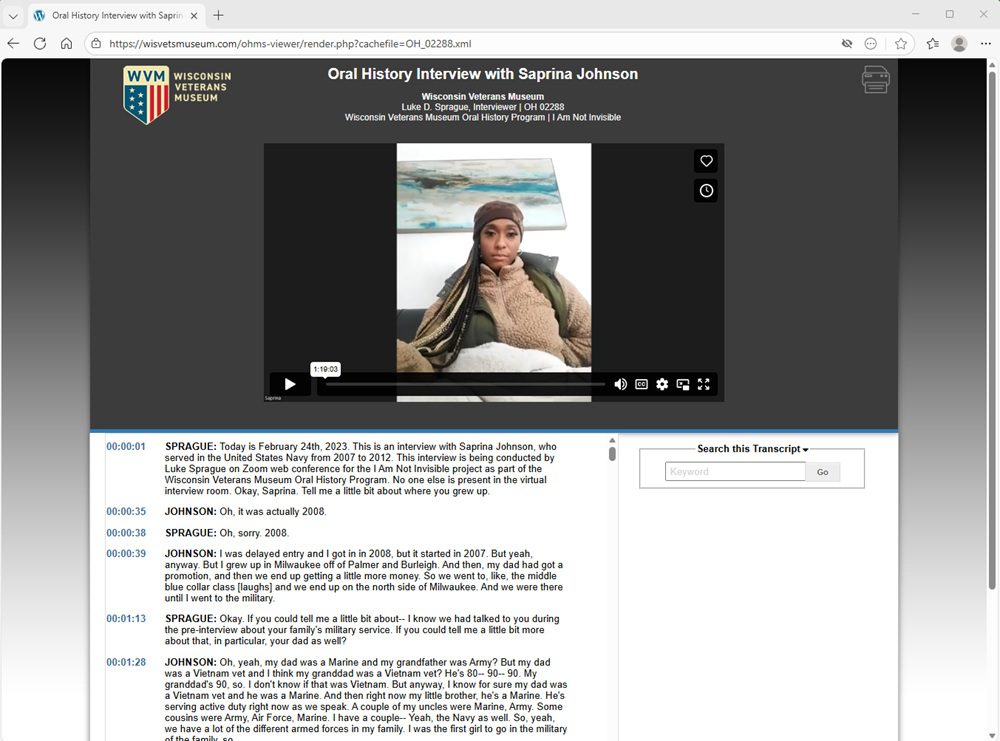
Even though she had been raised in a military family, Saprina Johnson’s choice to join the military was her own. Raised in Milwaukee, Johnson grew up around veterans in her own family.
JOHNSON: Oh, yeah, my dad was a Marine and my grandfather was Army? But my dad was a Vietnam vet and I think my granddad was a Vietnam vet? He's 80-- 90-- 90. My granddad's 90, so. I don't know if that was Vietnam. But anyway, I know for sure my dad is a Vietnam vet and he was a Marine. And then right now my little brother, he's a Marine. He's serving active duty right now as we speak. A couple of my uncles were Marine, Army. Some cousins were Army, Air Force, Marine. I have a couple-- Yeah, the Navy as well. So, yeah, we have a lot of the different armed forces in my family. I was the first girl to go in the military of the family, so.
When Johnson expressed interest in joining the military, her father pushed for her to attend college instead, but still gave some advice: join the Navy, the Air Force, or the Coast Guard. This choice was made easier for Johnson when she attended Bay View High School and joined the school’s Navy JROTC. From early on, she was set for Navy life.
Johnson’s NAVY JROTC instructor, Donnelly, left a life-long impression on her. Remembered as always wearing a white uniform, Donnelly inspired Johnson to join the Navy because she wanted to be “a girl version of him,” someone who was well-respected and supportive of others. Johnson was one of Donnelly’s favorite students, as she excelled in classes and physical tests. In general, Johnson's Navy JROTC experience was positive.
JOHNSON: I'd seen the ROTC program and I loved it. I love the uniform. I love how it was teaching stability, how it was teaching, like, it had a routine to it. I just liked routine. I've always been like that. Always had to have a routine. I don't know. Rules [laughs].
Ready to join the military right after high school, Johnson graduated in 2007 and was prepared to leave immediately. However, she suffered a car accident and ended up doing delayed entry. Johnson entered the United States Navy in 2008 and began boot camp at Recruit Training Command, Great Lakes, Illinois.
For Johnson, boot camp was a time for making lifelong friends. She recalled boot camp as being “nicer” and more fun than her later service, where she and her fellow recruits supported each other in study groups and ensured everyone passed their tests. Her leaders were similarly supportive, with a racist incident being definitively shut down as it arose. Boot camp consisted of a mixed-gender cohort. Women frequently helped the men with academic pursuits, while the men assisted the women in training for physical tests.
After boot camp, Johnson attended C School at Great Lakes, where she trained to be an engineer after a high ASVAB score in engineering. She was then assigned to the USS James E. Williams (DDG-95), stationed out of Norfolk, Virginia. Johnson served as the only woman in her division. She worked almost exclusively in the boiler room, isolated from others, with not much to do except sit in the dark and watch movies. Johnson believes she was poorly trained and left to fend for herself, which led to poor work performance that got her into trouble. Johnson describes a time when there was a fire drill in her boiler room, and she had no idea how to respond, resulting in her being yelled at by the fire squad after the boiler room flooded.
JOHNSON: Yeah. We did. Yeah, we had an intake and we had the whole little cleaning system. We had the whole system going. And I messed up 'cause [laughs] I didn't open one valve [laughs]. Oh, man, that was horrible! We had water all the way up to like, my calf in the ship because I did that. And then some places flooded, all the way flooded. Oh, it was messed up, I messed up so bad [laughs]. And it was like that for hours, too. And I was looking. I kept going to look back at the-- at the-- Oh, man, it was a little-- Oh. What was that thing called? It was like a little meter thing, and I was waiting, I'm like, it ain't moved! It hasn't moved! I'm waiting on it to move so I can turn the valve! And it hasn't moved. I noticed it was started shaking, and I was like, huh? Then all of a sudden I'm getting yelled at through the ship on the PDA thing. Like, "Get your ass up here! Right--" I'm like, oh, shit [laughs]! I'm like, what happened? Then when they said that this happened, this happened, "now we're standing in the water." And I was like, you know, I rose my hand. I was like, "Yeah, I think that was me. I don't know." And then I asked them to check each one of the valves. I was like, "I think I did this, this, this and this. And I think that"-- and he was like, "You didn't open this!" And that's when they-- yeah, people were mad at me for a long time. But again, that was my first time down there. We talked-- I was told in less than a couple minutes on what to do and I'm like--
INTERVIEWER: Yeah.
JOHNSON: Okay, I think I got it, and then left alone for hours [laughs].
INTERVIEWER: Yeah, it sounds like bad training to me.
JOHNSON: It was. It was. It was. It was very sexist. Very sexist.
After this experience, Johnson was forced to scramble to learn how to do her job without assistance from her division. It became apparent to Johnson that not only was she not receiving proper training, but she was being treated differently from the other people in her division, who were all men.
INTERVIEWER: Wow. A lot of pressure there with having to know all that, but not necessarily getting all the training that you needed.
JOHNSON: Yeah, 'cause it was like, "just put her down there" and then like, it was like, a dismissal. Like, my senior chief was very dismissal of me. He was just like, "Go put her over there. Just put her there." But he was very interactive with the guys on the-- in the division, but it was like for me, he was just like, "Just put her over there. Go to the same place you were doing." And I'm like, "Okay, what am I supposed to be doing?" I'm like, "do he even know I'm here [laughs]?
Her experiences in the Navy thus far had been vastly different from her time at boot camp and NAVY JROTC, where she was surrounded by helpful comrades hoping for her success. Her division chief, in particular, was nothing like Donnelly from the Navy JROTC.
Johnson was frequently not informed of when and where her watches were. Members of her division, as well as other people aboard the ship, would take advantage of Johnson’s lack of knowledge and force her to take their shifts. These experiences soured her on remaining in her division, prompting Johnson to decide to become an operations specialist to move on from the boiler room.
INTERVIEWER: So, I know you talked about that a little later on, deciding to become an operations specialist.
JOHNSON: Yeah, because that was like, okay, I don't like that I had to get in trouble to learn my job. Twice. I got in trouble twice to learn my job. Like, I didn't have the proper training. So, that's what made me go into another division. Like, I don't like that I'm not getting the proper training. So, that's what made me go into operations specialist, where now I'm just-- now that was even worse 'cause I was just sitting in a dark room looking at computer screens. I did that for a little while. Then I went back to being an engineer 'cause I couldn't take that no more.
Luckily, when Johnson transferred back to the boiler room as an engineer, she worked with a new petty officer first class who was very helpful. According to Johnson, this petty officer ensured that she was properly trained and had access to the engineer's office and lounge. Johnson continued to have some positive experiences aboard the USS James E. Williams, including swimming with wild dolphins.
After some time, Johnson experienced a traumatic event that led to the end of her military service. She received an honorable discharge and returned home to Wisconsin. After her enlistment, Johnson worked as a security guard. She attended Milwaukee Area Technical College, received an associate’s degree, and then transferred to the University of Wisconsin-Milwaukee. She then obtained a bachelor’s degree in business administration. Throughout this time in her life, Johnson struggled with identifying as a veteran.
INTERVIEWER: Do you think-- Did you-- Did you shift ever towards identifying as a veteran? And when did that happen, if it did?
JOHNSON: Um, well, I had went for my benefits because my dad was like, "At least get your benefits." But I still didn't identify. I would just do my stuff for the benefits. But that was it. I still didn't identify. Then I had a hard time getting my benefits too. So I'm like, I had to fight that for like two years, three years. [Inaudible] to get help to pay for school. So, I'm like, okay. But eventually I started to identify when I actually stepped foot into MAVRC [Military and Veterans Resource Center at the University of Wisconsin-Milwaukee]. Jane was there. And Tanner, who I'm still friends with. He was at the front desk. He's a cop now for Greenfield. But he was one of the first students that was sitting at the desk, one of the working students. He was sitting there at the desk and Jane was there. And I was like, oh, this is somewhere I can come study and it's quiet in here. There's not too many people in here. But then I noticed at a certain time, an hour, it was full of white men. I was like, oh, I do not fit in. I need to leave. And Jane was like, "No, have a seat. You are a part. You are a veteran. You're here. They will respect you." She changed a lot to make them respect me in there. And then a lot of the guys were very cool, and I didn't expect that. Like, it got to the point where we started our own little daycare in there, we were like, watching each other's kids while the other one go to class. I'm still friends with Sam. Sam Rogers from there. That's my homeboy. Like, and his three girls, you know? It's like, you know, I'm-- Evan, you know, those guys. Those guys are-- they all white men [laughs]. You know? And it was-- It was-- it opened up my eyes and they even said the same thing. Sean was like, "Hey," he was like, "if we can get more veterans in here that look like you, maybe veterans will want to call us inclusive." And I was like, "Yeah," 'cause at first when I came in here, I was like, "No, this is not for me." He was like, "Exactly. But you stayed and you got to know us and we got to know you." And when he said that, that's when a lot of other minority women started coming in. And 'cause I started inviting minority women, you know, into the MAVRC and then a lot of minority women really was coming in here and it became very inclusive. So I was like, "okay, you know," like they're talking about their different stories. And one of the guys, he was like, "Yeah, I was just a painter." He was like, "I was just painting." And he was like, "I feel like I was pushed aside and all I did was paint." And so when he said that then, I was like, "So I'm not the only one?" So that's what made me want to really start identifying, like talking about me being a veteran, was being in MAVRC [laughs]. Now I met you [laughs]!
Hanging out at the MAVRC changed Johnson’s life for the better. MAVRC’s director, Yolanda Medina, eventually connected Johnson with the Wisconsin Veterans Museum through the I Am Not Invisible Project. The initiative to highlight the stories of women veterans allowed Johnson to participate in the interview and share how her feelings about the military, identity, and representation have evolved over her life. After experiencing sexism and being a Black woman in the military, Johnson had a lot to share.
JOHNSON: Um, so. It's just the whole stereotype around women period. And then on top of that, being a minority woman serve in the military. It's like-- It is very sexist. There's always trauma around it because a lot of women have been-- they have had events similar to mine, um, sexual assaults and stuff like that. So, we don't want to identify. When you first think of a veteran, you always think of a white male. You don't always think of who else was there, who else served. There was minority men, there was minority female. There were white females. You know, so, some people don't think about that right away. So I started wanting to break down the stereotype of a veteran being just a white male. So that-- and it's crazy because that came from a white male [laugh]. When he brought that to my attention, when he said--his name was Sean--he was like, "we need more people in here that look like you that want to identify as veterans." And when he said that to me, I was like, it resonated with me. And that's what get me involved in the SVA. Student Veterans of America, I became the PR, the public relations officer, and then, you know, and I got voted for. I didn't want to run, but everybody in there was like, "No, you need to run for that." And I ended up winning by like 97% [laughs]. I won. And I was like, "Oh my God!" And it was like, I can't believe all these guys actually voted for me to do this. And they're like, "Yeah, because we respect you. We respect what you're doing. We respect what you're going for. We know what you're doing." So. That's what made me, was like, okay, I think I can change my perception about being a woman veteran. And a minority woman veteran. And like I said, that's when a lot of women started really identifying, when they was like, "Wait, you going in there?" And then I go in there with my daughter, a toddler. They're like, "Wait, we can do that? I can go in there?" And then, eventually, the LGBTQ community had veterans. There was a transgender veteran that was like, "I can't go in there." I'm like, "Yes, you can. Come on, come in here with me." And they start going in there. He is now she, who identifies as they now. So they go-- they go in there, or was going in there and was welcomed. You know, some of the guys, they did pull a little stunt. They were being assholes a couple of times. But it's-- you got to get off-- It's just about educating them. Like no, we are all service. Not all servicemen look like you, you know. So. That's what I-- that's what made me want to start, 'cause I noticed that there was other people that [cell phone vibration] wanted to identify but couldn't identify. And felt that they would have been excluded because they don't look like the normal white male. So, I was breaking down-- breaking down those barriers. I'm like, hey, I might be one woman, but I actually do have an army behind me and they are white male and they are willing to do this with me [laughs]. So, yeah, I got a few guys that I'm still friends with that highly respect me. We talk stuff every day [laughs].
At the time of the interview, Johnson spoke about how she served for her father, herself, and other veterans of color. She again remembers her NAVY JROTC leader Donnelly, who “carried himself with respect and honor” and served “for people.” Johnson continued to want to emulate Donnelly’s love of people in her work as a veteran. Johnson began working with WoVeN (Women Veterans Network) and thinking about how best to serve her community, whether that’s veterans from marginalized groups or people of color in general.
JOHNSON: That's all that really matters to me, is helping my community. That's why I work in mental health as well. You know, a lot of people of color don't know the resources out here for mental health. They think it's a-- It's a-- it's a-- don't want to be rude, but they think it's a "white people go to therapy" thing, and it's like, "No, you can go to therapy too. It's here for you too," you know? So, try to help people in the community. Build awareness. I don't know. I'm trying to stop all the curses [Both laugh]. You know. I mean, all the-- all the minority curses, all the, you know, I don't know, the trauma curses. I'm trying to stop them. Trying to stop 'em. You know. At least within myself and within my family and people around me. Where I can do it. So, yeah, I guess that's as much as I'll give you about what I do for work.
For Johnson, service in the Navy was marked by difficult experiences. However, positive memories of great leadership, supportive friends and family, and welcoming veterans at MAVRC have allowed Johnson to step into the role of a supportive veteran for others. In her work in mental health and with veterans’ organizations, Johnson has shown the importance of respecting oneself and respecting others. In her drive to be present as a Black woman veteran, Johnson shared her story with the Wisconsin Veterans Museum and completed her interview with representation and support in mind.
JOHNSON: It's a great opportunity. You know, you were saying, like you're out there in the museum, and it was a great opportunity to show, you know, be a part of something bigger, and like, you know, this is considered my platform that I can use to keep showing and keep showing up for minorities, veteran women. Like, this is my-- I'm using this platform for that. So, yeah, that's my motivation too.
Click here or the image for the full and complete interview of Saprina Johnson's oral history interview: