
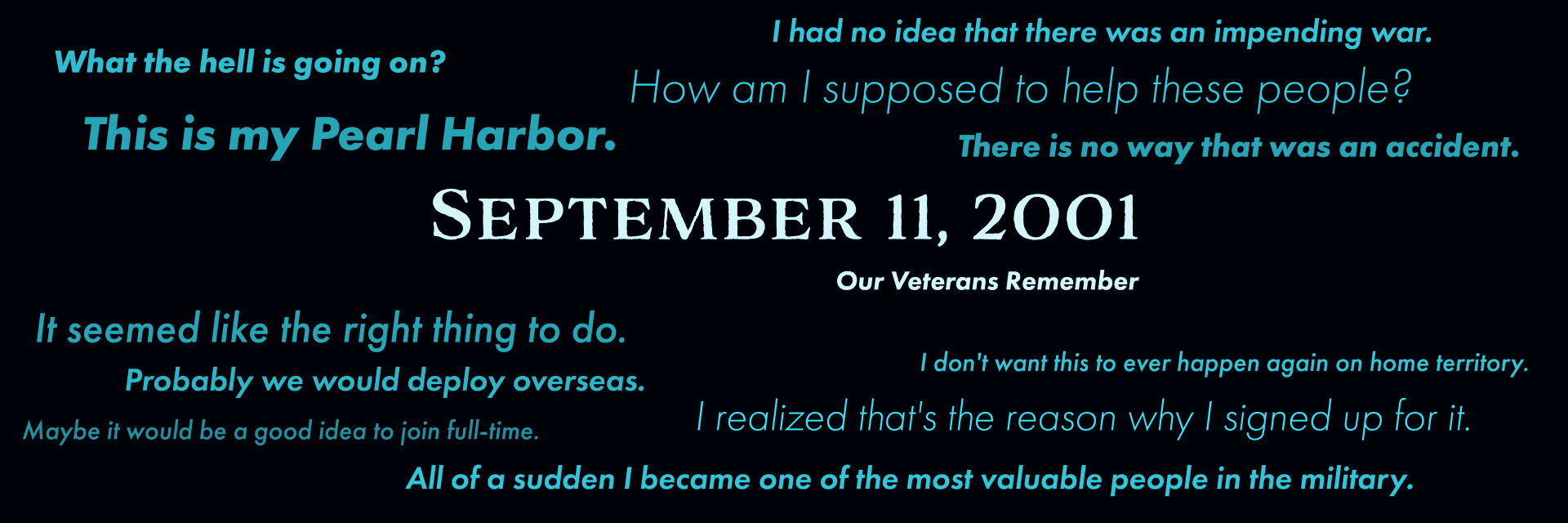

This virtual exhibit September 11, 2001: Our Veterans Remember, includes reactions taken from oral history interviews of Wisconsin veterans who were active duty, had recently separated from service, or were contemplating enlisting at the time of the terrorist attacks. The events of September 11, inspired many to serve, while others were more reticent; all put on the uniform and took the oath to support and defend the Constitution of the United States against all enemies, foreign and domestic.
Shawn Corcoran, U.S. Marine Corps
Shawn Corcoran of Madison served with the U.S. Marine Corps during the Persian Gulf War, Somalia, Bosnia, and the Iraq War. Excerpt from OH 00965.
"So I had a really good job. … And I missed the Marine Corps from time to time but, you know, once a Marine, always a Marine. I was putting on weight over the years, yeah, and kind of going about my business. And then, before I knew it, I was at work one morning. We used to gather at work, the Engineering Department would, and we would watch the news, or whatever was in TV. And here I see this burning building, on the news. What the hell is going on there? It's the downtown cityscape, of New York. The burning building was the Trade Center. So we were trying to figure out what is going on and I watched the plane go into the building. So we were thinking, private plane attacking the building. And then as we were watching it, another plane crashed into the building. And I remember telling them in there at that time. And then once we started figuring out it was probably a terrorist attack on the country. I remember saying to them, "Whoever did this is going to pay. I guarantee you. We'll retaliate." And I think that really got the wheels spinning again.
I heard a lot of people talking about how this affected them psychologically. You know, they were going to seek counseling, and things of that nature. But I don't think it was with me. But I found myself listening to the news running at the time, the AM stations, CNN, Fox News, twenty-four hours. That never happened. And I ended up sitting in my vehicle at work, listening to the news all day. I didn't want to do anything else. Had no ambition to do anything else. So I thought, well, I am going to go in the Reserves. This is my Pearl Harbor.
… I was wondering if we were ever going to be called up. On account of we were waiting for the word. We might be called up. Might be called up. Afghanistan was going on at the time. Watching the news. September 11 occurred on September 11, 2001. I ended up going in the Reserves in October, 2001. Somewhere around there. Late October. But I started playing with the idea of going back on active duty full time. Needless to say, my wife wasn't real excited about that.
Came back on active duty at the same rank. I wanted a unit that was either infantry. Or combat arms. I wanted something combat arms. No infantry unit was available, not possible. So I took an artillery unit. Out of Camp LeJeune. It was 1/10. First Battalion, Tenth Marines. Tenth Marine Regiment. Ended up getting orders for there. Leaving, which was the hardest day of my life, because I remember leaving my boys to something where I wouldn't see them on a daily basis.”
Jeffrey Carnes, U. S. Army
Jeffrey Carnes of Jefferson, WI served as an Arabic linguist with the U.S. Army from 1997 to 2004, and as a reservist from 2004-06. Excerpt from OH 01413.
So, at the same that I'm taking Russian there was this--there were two veterans in the class. And one guy, he was a real character. And he was talking about the Defense Language Institute, which is out in Monterey, or DLI. And he was talking about DLI, talking about how it's such a great place to learn languages, he just didn't want to reenlist in order to go to DLI. So he got out and decided to learn Russian at UW. So I started asking him some questions, I asked some professors questions, they didn't really wanna talk about DLI. They said, "Oh, it's a great place." And then they'd change the subject. So I started looking into it, and I thought, well, for my 00:33:00future this seems like a pretty good idea. And considering the fact that, with the GI Bill and everything else, that I can come back here eventually and finish up my degree and get a little bit of adventure. I guess I'm a little bit of an adventurous type.
And so, the Army, in its infinite wisdom, after I took the aptitude test to see if I could learn a language, decided to put me in Arabic. And all that Russian went out the window. And this, mind you, was the late '90s, where no one really thought that there was gonna be a war again. It was the shiny, happy '90s and everyone's happy. And so, when I'm taking Arabic it was more of a novelty. It was still one of the larger language programs at DLI, but Korean was still a little bigger. So, um, and so I ended up just taking Arabic, that's what the military put me in. Went through all my training and then ended up at Fort Campbell. And so, kinda indirectly through UW, and through the Russian Program, I ended up going to Iraq of all things…So all the sudden when 9/11 happened, all of a sudden I became one of the most valuable people in the military.
John McNally, U. S. Army
John McNally of Necedah, WI served as an infantry lieutenant and special forces captain from 1996-2005. Excerpt taken from OH 01415
Interviewer: When 9/11 happened what was your initial reaction?
McNally: "What the hell is going on?" I don't know, I really didn't have too much of a reaction at that point. I was kinda focused on the training because I realized that within a matter of months this was gonna involve me more so than--at least immediately--more so than any part of the Army. Because that was my specialty area, was gonna be sub-Saharan Africa as well as the Afghan/Iraq area.
Interviewer: So 9/11 happens, so basically you had an initial kind of, "It's on now."
McNally: Mm-hm.
Interviewer: "This is where I'm gonna get called in," kinda thing?
McNally: Yeah.
Interviewer: So after 9/11 describe what happened to you and your service and your training at that point and kinda gearing up to going to wherever you thought you were going to go.
McNally: Okay. Um, well at that point they--5th Special Forces group, they were the ones initially slated, they went into Afghanistan first, along with elements of the CIA ahead of time and a couple other military groups. And 3rd Special Forces group got the order that they were going to be following in behind the 5th Special Forces. So I reported to my team…
William Schuth III, U. S. Marine Corps
William Schuth was an infantryman with the U.S. Marine Corps from December 2002-December 2006. Excerpt from OH 01419
I joined the service for a variety of reasons but it was right in that year after 9/11 and it seemed like the right thing to do.
Paul Dolan, U. S. Marine Corps
Paul Dolan of central Wisconsin enlisted in the U.S. Marine Corps in July 2001 with the delayed entry program. Excerpt from OH 01431.
Interviewer: So then the 9/11 attacks occurred while you were in the delayed entry program. How did you feel about that when the attacks happened? How did you find out about it?
Dolan: I was actually in school, in high school. And I remember showing up to school late that day and all the teachers and principals were all running around talking about planes hitting buildings and I really didn't understand what was going on until I sat down and started watching the news. And the interesting thing in my mind was being in the delayed entry program, you know, I was kind of like on standby for military service so I thought maybe within a month or so I'd be pulled out of high school and start serving. Which at first I was kind of scared, but then I realized that's the reason why I signed up for it.
So I was kind of prepared for it. I kind of, I mean I was expecting it, but that was unrealistic. So then I actually served first my high school to maintain my deployment day for boot camp in July of 2002. So I mean I was up and ready and eager. I mean at that point just to tee my career as a Marine and kind of give me more of a goal is the reason why we're doing what we're doing.
Laura Naylor, Army National Guard
Laura Naylor of Waupaca, WI joined the National Guard early in 2001.
Naylor: I actually joined the second semester of my freshman year in college. I was in CREW, and I didn't know what I wanted to do that summer. I couldn't afford to stay in Madison and pay for college and an apartment, and I did not want to go back to small-town Wisconsin, so I decided to join the National Guard to help pay for school, and to have some adventure in my life. And that was six months before September 11th, so I had no idea that there was an impending war.
Interviewer: So tell us about your first experience--getting, mobilizing for war and what was it like to receive the news that you were headed overseas?
Naylor: There was a lot of mixed emotions when I first found out that I was going to be deployed. A little angry for the fact that I was--I did have a life here at home, and I was in school, and I had to get taken out of the middle of a semester. However, when we got over there, it was more of a really cool adventure at first, and it wasn't that scary, and I loved the adventure aspect of it. Until we started getting extended, and extended, and extended, and then we were over there for sixteen months as opposed to six months, and things just went from bad to really bad, so.
Yvette Pino, U.S. Army
Yvette Pino of Madison, WI enlisted in the U.S. Army after the 9/11 attacks. Excerpt from OH 01424.
After September 11th ... I think there was just a weird feeling of uneasiness that I was really confused about. I felt like, by watching the news I didn't understand what was going on, the politics in the world. One of the things for me was, the only way I'm really going to understand is if I involve myself in it and I don't want to be in politics, so I thought, If I'm in the Army and we have to go to war then at least I can comprehend either the purpose of it, or the behind-the-scenes so that I actually have a voice that's educated as opposed to just watching media.
...I went to the recruiter to seek out information on Army Reserve. We were in talks and I was getting my workout regimen settled, and I had to lose some weight to get in. So, while all that was happening, September 11th happened. After September 11th, literally right after I heard about it I thought, the recruiter's going to be calling me like any minute. I was staring at the phone. Sure enough, a few hours later the recruiter called to update my status and to see how I was coming along on my workout. Basically, he was calling to find out if I was still interested. I knew what the call was about. He knew I knew what the call was about and I said, "Unh-uh, no thanks, I'm good."
He was a real good guy and said, "What are you scared of? Why are you not interested all of a sudden?"
I was like, "Have you not seen the news?"
He basically tried to sweet talk me into joining and I said, "No thanks."
I hung up the phone and then in the ensuing weeks I was watching the news, and watching everybody start getting ready to go on deployments, and just watching the politics behind everything. I felt really guilty for doing what I did, so I went back to the recruiter. My job was coming to a point where it was becoming--there was no more outlets for me to advance. I realized that, between the guilt and the idea that my job was at a dead end that maybe it would be a good idea to join fulltime.
I called the recruiter back and I changed my status to interested, and instead of Reserves, fulltime. I lost the weight that I needed to lose within about a month, and then got all the paperwork, and then I got shipped out.
Adam Holton, U.S. Marine Corps
Adam Holton of Milwaukee, WI is a 1993 graduate of the U.S. Naval Academy who re-enlisted in 2003 and served as a captain the Marine Corps Reserves. Excerpt from OH 01793.
So I remember 9/11 I think like everybody does. I came home early in the day once we got a sense of what was happening. You know you call and you check in on all your family. I had a brother who was working in Chicago at the time in the Sears Tower. We were telling him, "Get out of the Sears Tower," because you don't know is this just New York and then the D.C. thing happened. I think in Milwaukee, Wisconsin, in which we were living at the time, we got an appreciation of how bad 9/11 was.
Now times that times a hundred by being in New York in and around people where everybody I worked with knew somebody who was directly a part of 9/11. I had friends--Scott Conway comes to mind--went to school with him. Scott Conway had gotten out of the Marine Corps prior to 9/11 and after 9/11 went back in the Marine Corps full time. He's not the only one--there are so many examples of that.
But now I see friends of mine who are going back in. Shane Tomko--who was my commanding officer at the Basic School, one of the best friends I'll ever have, I've already talked a little bit about him--but his unit goes to Afghanistan. Fred Fredrickson--I'm godfather to his daughter--he goes to Afghanistan post-9/11. You start to hear about other things that may come down the pipeline.
I remember one day thinking to myself, what am I doing? What am I doing? How am I not a part of this when you've got brothers who are going to battle to be a part of it and I'm sitting here--sitting this out. That didn't feel good; it didn't feel good at all. So I talked with my wife about it. When we moved to Illinois now I'm in proximity to a Marine unit. There's no reason not to be a part of this. 2nd Battalion, 24th Marines--which is the unit out of Chicago--they were in the pipeline to go, whether it be to Afghanistan or Iraq.
After a lot of consultation with my wife because ultimately I go back to she didn't sign up for this. If she wasn't going to sign off on it, it wasn't going to happen. After a lot of consultation I decided to get back into the Reserves knowing probably--hoping is the wrong term because I don't think anybody hopes they go to war--but knowing that probably we would deploy overseas...
Brian Martens, U.S. Air Force and Air National Guard
Brian Martens of Madison, WI was on duty at Volk Field when the 9/11 attacks occurred. Excerpt from OH 01768.
And the night of 9/11, or the day of 9/11, I remember exactly where I was. I was getting off a shift about eight in the morning at Volk Field. My fire chief came out and he's like, "A plane hit the World Trade Center." "What are you talking about?" Go in there, and there's this big giant hole in the north tower. And I thought about it and I thought about it, and I was like, "That hole is right in the center of that building. There is no way that was an accident."
And as we were watching that second plane hit, I was like, "My God, it's--you know, think about all the firemen, cops, port authority, everybody--all the office workers still in that building, that was very well timed."
And I hate to say it, but that operation, the 9/11 operation was actually quite brilliant because they caught us with our pants down, literally. We had alert jets like we've had since the Cold War, you know, all along the eastern seaboard, western seaboard, but that's something that they would never have expected. If I would have told anybody on September 10th that "Hey, tomorrow nineteen guys are gonna hijack four airplanes and kill three thousand people in three different areas." I would have been committed, you know [laughs], been in the rubber room.
That night, I reported to the base out here at Truax and I told my boss, "Do not send anybody without me." Because, I'm ashamed to think of it and say it, but that night I really, really wanted to go over there and kill somebody. I was very upset, I was very pissed, I was--I'll try to keep the profanity to a minimum, here --my wife at the time was crying asking me what the hell is going on. I couldn't give her a straight answer.
Four months later, I left to go to Bagram, Afghanistan, 2002-- January. And I was--I was--I believed in what we were doing. I believed in what we were doing in Desert Storm very much. I believed in what we did in 9/11 immensely. You know, and I--when I finally got my orders down, I had to tell my wife, I was like--and I was really scared about telling her because our orders, initially we were going to be gone for a year. And, I knew where we were going-- Kandahar. We got diverted on way, we went up to Bagram, which wasn't much better.
But, yeah I sat at my wife's work in the break room and told her I was going to be gone for a year, and we had a--two and a half year old son at the time. And she took it very well. And I admired her--we're no longer married, but to this day she still e-mails to say "Happy Veterans Day, I'm very proud of you," and stuff like that.
So yeah I left, and probably one of the few times I've ever cried during the military was on that trip out, on the plane out, 12 'cause--you know, the immediate family, I'm left with five other people; all firefighters within my unit out there at Truax. We've known each other, you know, intimately the last couple years. None of us were strangers. And as we were leaving, the sergeant came in and said, "Hey, guys,"--as we were saying goodbye to our families he's like, "Guys the bus is ready, plane's ready, it's time." And then my son really knew something was up because my wife was crying, my father was crying, my mother, sister were crying, and as I left, you know, he just started crying, "Daddy, daddy." I just walked straight out. According to sources later there wasn't a dry eye in the house.
Kit Amidzich, U.S. Army
Kit Amidzich of Delafield, WI enlisted in the U.S. Army after the 9/11 attacks. Excerpt from OH 02181.
I knew Army was where I wanted to be. It felt right. It was--it just--you just n-- I just knew. So, National Guard, started talkin' to recruiters in probably right around that '99, 2000 mark. And they were like, "Okay, this is what you need. This is all your paperwork. Take your ASVAB [Armed Services Vocational Aptitude Battery]. Do all that stuff." So, I was prepping, like, really. I was gonna do delayed entry, um, just 'cause I wanted to, you know, work it out with my work schedule and all that stuff.
Uh, but then September eleventh hit and that changed everything for me.
Interviewer: Walk me through that--that day, um, being in Washington--
I actually lived in Leesburg, Virginia at the time--of 9/11, which FAA [Federal Aviation Administration] was my backyard. That's--literally they were--there was a big fence and the FAA was right there...And I remember getting a phone call from my mother and norma-- like, I worked late that night so I slept in late so it was about--it was right after the first plane crashed into Tower 1, I believe. And, uh, sh-- I get a c-- phone call. It woke me up. And I grabbed it and I remember my mom saying, "The country's under attack. You need to get up. Where are you? What's going on? Are you okay? Are you safe? Um, I haven't heard from your sisters." Both my sisters worked right next to The Pentagon ...for a--a booking company.
And, um--and I was so sh-- I was like, "What are you talking about?" Like, I was so confused. You know, I'm waking up. And then I get up and I realize, oh, no, she's--she's absolutely right. Went and turned on the TV and was just shock. I think shock is the best word for most people. Um, but anger and frustration immediately came out, like, how dare they attack my country.
My patriotic duty, uh, ramped up a little bit. You could say that in the least. Except they shut down all the roads and they wouldn't let us out of our apartment complex. They wouldn't let us drive anywhere.
Everything was shut down 'cause we were right next to the FAA. And they--they knew there was another plane out there. They didn't know what was going on. I mean, it was just total collective chaos, right. So, I walked to my sister's house, which was three, four miles. And got to my older sister-- she stayed home that day 'cause she wasn't feeling good. But my middle sister went to work. And we were in--we w-- she was trying to contact her and see if she was okay and all that stuff. And finally the phones--'cause, you know, the phone systems were shutdown 'cause everybody was calling everybody. So, we finally got through to my sister and found out that she was safe. They made it to work before the plane crashed into The Pentagon, but that they could see the smoke and it was really bad and there was total collective chaos down there. Uh, firefighters came in and gave 'em all masks to wear because the smoke was so incredibly bad that it was billowing into their office. But they [laughs] really couldn't leave 'cause they weren't letting anybody go anywhere, which was really scary. And, um, we were glued to the TV. And I just remember--sorry.
I just remember, um, feeling so helpless, like, I can't do anything. How am I supposed to help these people? I've gotta get to--to--to f-- to New York. Uh, we were only roughly a four and a half hour drive away. And I was makin' all these plans and I was calling all these people like, "We need to go up there. We need to volunteer. We need to take supplies. We need to do this." Like, I can't just sit and watch this. And then the second tower got hit, and I just broke down and lost it.
And, obviously, it's still a very emotional moment for me 'cause it changed my life completely. [sniffles]
Um, my sister finally got home really late that night. Um, and she had soot on her. Like, she was--it was--it hit home.
I lost some friends at The Pentagon. Um, they were doing duty there. And, uh, so, it was really an emotional moment for me. Uh, couple days later I got through to my recruiter and said, "All right, active duty, four years, let's go."
And [inaudible] one of those moments where I was like that's it. Let's do it. Like, there wasn't even a hiccup. He's like, "For real?" And I'm like, "Really? You're gonna ask me for real in this moment?" I said, "Next basic training get me out." And so that was September l-- like, fourteenth, fifteenth, whatever it was that following Monday. And I shipped out to basic training on November 22, 2001 ready to go.
Ashley Smits, U.S. Air Force
Ashley Smits of Suamico, WI enlisted in the U.S. Air Force after the 9/11 attacks. Excerpt from OH 02290.
A lot of it was really 9/11. You know, I was a freshman when 9/11 happened. I watched it live, happened on TV. From there, my older brother joined the Army National Guard. And then really, I wanted to follow in his footsteps and I wanted to serve my country.
Interviewer: Okay. And if you could, what motivated you to join the military?
Smits: A lot of it was really 9/11. You know, I was a freshman when 9/11 happened. I watched it live, happened on TV. From there, my older brother joined the Army National Guard. And then really, I wanted to follow in his footsteps and I wanted to serve my country. And he, having gone that Army route, he really pushed me to join the Air Force instead, for the better quality of life.
Interviewer: Okay. A couple of things. Uh, curious. Where were you? Literally, 9/11 happened. What were you doing? Yeah.
Smits: So I was a freshman. I was in school. I was in a fashion and interior design class. We were working on sewing projects and we had TVs in all of our classrooms. And so we literally had the TV on, um, you know, while we were working on these projects. And so we just, we saw it all unfold throughout the, you know, throughout the day on the TVs. They kept us in school and then we pretty much just watched the news that whole day.
Interviewer: That must have been a pretty intense experience.
Smits: Yeah, I think, you know, I think, you know, being a freshman, I think you're still naive of what was really happening. Um, you know, when the first plane hit, you know, everybody's in shock and, you know, was it a mistake? And then when the second plane hit and then, you know, the Pentagon and when it went down in Pennsylvania, and then you're like, okay, this is real. And already having in the back of your mind, you know, kind of even that the military was a possibility, that just solidified it to say, you know, I don't want this to ever happen again on home territory.
Add a Wisconsin veteran's photo to the story
The Wisconsin Veterans Museum endeavors to collect a digital image of every Wisconsin veteran. Click on the button to upload a photo and tell us about the veteran. Images may be used in a future digital exhibit and will be retained in a digital archive.